Healthcare data breaches cost an average of $7.42 million per incident, according to The HIPAA Journal. It’s the highest of any industry for the 14th consecutive year. For a busy physician or office manager, the risks are real. A single compliance gap can lead to fines, an investigation, and real reputational damage among patients.
That is why HIPAA compliance in healthcare is so critical to running a practice today. It affects how you protect patient data, manage risk, and keep daily operations running without disruption.
The challenge is that the Health Insurance Portability and Accountability Act (HIPAA) has been around since 1996. Yet many teams still don’t understand what it really requires. People often treat it like a checklist you complete once. In reality, it’s an ongoing system. It shapes workflows, staff behavior, and your overall approach to data privacy.
This guide breaks it down in plain terms. You’ll see who must comply, what the HIPAA privacy and security rules require, and what violations can cost. We’ll also provide practical steps your practice should have in place right now.
Highlights
- Compliance applies broadly across the healthcare ecosystem. Providers, health plans, clearinghouses, and third-party vendors (business associates) must all protect patient health information. And third parties are a major source of breach risk.
- The three core HIPAA rules define how data is handled. The Privacy Rule controls use and disclosure, the Security Rule protects electronic data through safeguards, and the Breach Notification Rule dictates response timelines after incidents.
- Effective compliance depends on consistent, real-world execution. Practices must implement administrative, physical, and technical safeguards, follow the Seven Elements framework, and embed compliance into daily operations.
- Most violations come from everyday operational gaps, not complex attacks. Common issues include insufficient staff training, weak access controls, missing agreements, and failure to report breaches in a timely manner.
- HIPAA compliance in healthcare is an ongoing system, not a one-time checklist. It requires continuous updates to policies, workflows, and safeguards as risks, technologies, and regulations evolve.
What Is HIPAA Compliance in Healthcare?
HIPAA stands for the Health Insurance Portability and Accountability Act, a federal law passed in 1996 and signed by President Clinton. It set national standards for protecting, storing, and sharing health information across the healthcare industry.
HIPAA compliance in healthcare isn’t a one-time task. It’s an ongoing way of operating. It requires healthcare providers to implement appropriate security safeguards and keep them up to date as risks change.
This means that strong administrative, physical, and technical safeguards are essential to protect PHI. (More on these soon).
Together, these form a working system. One that protects patient data from unauthorized access, use, or disclosure.
HIPAA is enforced by the Department of Health and Human Services (HHS), specifically the Office for Civil Rights (OCR). This is the body that investigates complaints, conducts compliance audits, and imposes penalties when businesses don’t comply with HIPAA rules.
The purpose goes beyond avoiding fines.
HIPAA exists to:
- Hold organizations accountable when data breaches or HIPAA violations occur
- Allow appropriate sharing of data for patient care and healthcare decisions
- Ensure secure, reliable systems for handling health information
- Protect patient privacy and sensitive personal data
A Brief History of HIPAA
When the U.S. Congress passed the HIPAA law in 1996, the goal was practical. Healthcare systems struggled to share health information efficiently. At the same time, fraud and misuse of personal data were becoming a real concern.
HIPAA helps tackle both issues. It helped modernize how information moved across the healthcare industry. It also addressed gaps in insurance coverage when people changed jobs while strengthening protections for patient data.
After the law passed, the Department of Health and Human Services issued implementing regulations. This is where the HIPAA Privacy Rule came in. It set national standards for how companies should use and disclose protected health information.
Over time, those protections expanded:
- Security Rule (2003): It introduced requirements to protect individuals’ electronic protected health information.
- HITECH Act (2009): It strengthened protections as digital systems became standard.
- Omnibus Rule (2013): It extended the responsibility to vendors and partners handling patient data.
There is a clear pattern here. As healthcare systems evolve, so do expectations around privacy and security.
Who Must Comply With HIPAA?
HIPAA applies to any organization that handles protected health information in the course of care, billing, or operations. In most cases, that includes your practice and the partners you rely on every day.
Covered Entities
Covered Entities are the organizations directly responsible for patient care and insurance processing. If you run or manage a practice, you’re part of this group. That means that, as a physician or office manager, you’re directly responsible for protecting patient data and complying with HIPAA requirements.
This includes:
- Healthcare providers: Physicians, dentists, pharmacists, clinics, hospitals, and nursing homes that deliver care and handle medical records.
- Healthcare clearinghouses: Entities that convert non-standard data into standardized formats for billing and electronic transactions.
- Health plans: HMOs, PPOs, Medicare, Medicaid, and employer-sponsored plans that manage coverage and payments.
Business Associates
Business associates are third-party providers that access or handle PHI on your behalf. This is also where risk increases.
According to Cedar Rose, in 2023, 60% of healthcare data breaches involved a third-party vendor, with an average cost of $10 million per incident.
Business associates aren’t part of your internal team, but they still interact with sensitive patient data through your systems and workflows. Outsourcing healthcare services can be beneficial. But you’re still accountable for how your partner handles sensitive data.
Common examples include:
- IT service providers and consultants: They manage systems and infrastructure.
- Medical billing and coding companies: They handle claims and payments.
- Electronic medical records vendors: They store and manage patient records.
Virtual medical assistants also fall into this category. They often handle scheduling, documentation, and patient communication, which involves access to PHI.
What Is Protected Health Information (PHI)?
Protected health information (PHI) refers to any individually identifiable health information that’s created, stored, or shared by a covered entity or business associate. It can exist in any form, such as electronic, paper, or spoken.
PHI includes:
- Insurance claims data
- Medical records
- Treatment plans
- Billing details
- Lab results
It also covers any data linked to a person’s physical or mental health.
When PHI is stored digitally, it is referred to as electronic protected health information (ePHI). The same rules apply. But the HIPAA Security Rule requires stronger technical safeguards to protect it.
The 18 HIPAA Identifiers
HIPAA defines 18 specific identifiers that constitute PHI. If even one of these is present, make sure to protect the data.
Common examples include:
- Technical and biometric data, such as IP addresses, device identifiers, fingerprints, and facial images
- Social Security numbers, phone numbers, and email addresses
- Medical record numbers and health plan beneficiary numbers
- Certificate numbers, license details, and vehicle identifiers
- Full name, address, and dates (birth, admission, discharge)
In practice, if even one of these identifiers appears next to health information, it becomes PHI and must be protected.
For data to be considered de-identified, all 18 identifiers must be removed.
The Three Core HIPAA Rules Every Practice Must Know
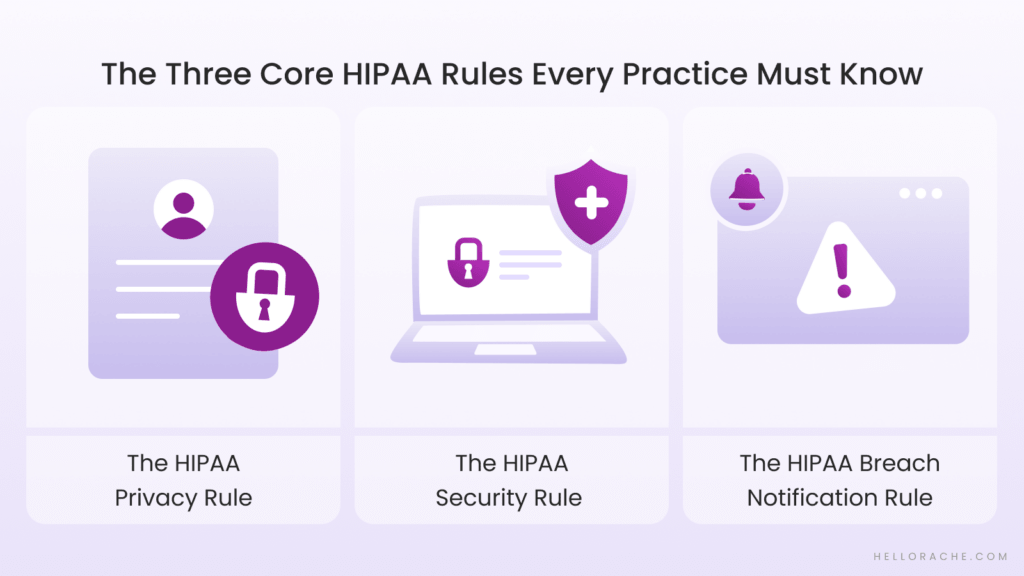
HIPAA consists of three core rules. Each one focuses on a different part of how you handle PHI. Together, they impact how your practice protects data, manages access, and responds when something goes wrong.
The HIPAA Privacy Rule
The HIPAA Privacy Rule establishes the standard for protecting medical records and personal health information. It applies to both covered entities and their business associates.
It limits how entities use and share PHI. The “minimum necessary” rule means that staff should access only the information they need to do their jobs.
It also requires written policies for how employees should handle PHI. These should cover both internal use and external disclosure of PHI.
Patients also have rights. They can access their records and request corrections when needed.
There are 12 scenarios where organizations can share PHI without patient consent. This can apply to situations like workers’ compensation claims, court proceedings, or organ donation.
Still, most issues come from everyday mistakes. Proofpoint found that human error remains a leading cause of healthcare data breaches.
The HIPAA Security Rule
The HIPAA Security Rule focuses on ePHI. It deals with the systems and tools that store and transmit patient data.
It requires three types of safeguards:
- Technical safeguards: This involves features like encryption and audit controls to safeguard electronic protected health information (PHI)
- Administrative safeguards: These include policies, employee training, and clear processes for handling protected health information.
- Physical safeguards: These refer to the controlling access to spaces and devices that store medical records.
These safeguards work together to protect the confidentiality, integrity, and availability of ePHI.
Unlike the Privacy Rule, this rule allows flexibility. Your approach can vary based on the size of your practice and your specific risks.
Common requirements include:
- Encryption of data in transit and at rest
- Disaster recovery plans
- Automatic logoff
- Unique user IDs
- Audit controls
The HIPAA Breach Notification Rule
The Breach Notification Rule explains what happens when something goes wrong. If unsecured PHI is exposed, action must follow.
Covered entities must notify affected individuals within 60 days of discovering a breach.
If a breach affects 500 or more people in a single state or area, it must also be reported to the HSS and OCR without unreasonable delay. In some cases, local media must also be notified.
Smaller breaches still count. They must be documented and reported to HHS annually.
However, not every incident qualifies as a breach. A breach involves impermissible use or disclosure of PHI that compromises privacy or security.
HIPAA Compliance Requirements: What Practices Must Actually Do
HIPAA isn’t just about rules. It shows up in how your clinic runs each day. From staff behavior to system access, compliance depends on consistent actions, not a one-time setup.
Censinet reports that in 2024, over 276 million healthcare records were exposed or compromised in data breaches. That number reflects how often protection fails when processes are unclear or inconsistent.
Administrative Safeguards
Administrative safeguards shape how your practice handles PHI behind the scenes. They define responsibility, guide daily decisions, and maintain consistent processes.
These are the safeguards you need in place:
- Designated roles: Assign a Privacy Officer and a Security Officer. In smaller practices, one person can handle both roles.
- Written policies and procedures: Cover PHI use, access, disclosure, and breach response.
- Workforce training: Train staff regularly, document it, and update it when rules or workflows change.
- Risk analysis: Perform a formal, documented review of systems and workflows that handle PHI.
- Sanctions policy: Set clear consequences for violations and document them when they occur.
Physical Safeguards
Physical safeguards focus on real-world access, such as who can enter a space, see a screen, or handle a device that stores patient data. Small gaps here are easy to miss but can lead to exposure.
Make sure to have these in place:
- Media movement and disposal: Shred paper records and wipe devices before reuse or disposal to prevent unauthorized access to sensitive data.
- Remote and virtual staff environments: Virtual assistants should work in private, secure spaces where PHI isn’t visible or overheard.
- Facility access controls: Use key cards, cameras, or sign-in logs to limit who enters areas where PHI is stored or processed.
- Workstation policies: Position screens away from patients or visitors. Set devices to lock automatically after a period of inactivity.
Technical Safeguards
Technical safeguards protect electronic protected health information inside your systems. This is where many modern risks show up, especially with cloud tools and remote access.
This category includes:
- Audit controls: Track who accessed PHI, when it happened, and from where. These logs are critical during investigations and audits.
- Encryption: Secure ePHI at rest and in transit, especially across email, cloud systems, and telehealth platforms.
- Access control: Use unique user IDs, role-based permissions, automatic logoff, and emergency access procedures.
- Transmission security: Use protocols such as SSL/TLS to protect data in transit across networks.
- Integrity controls: Detect and prevent unauthorized changes to ePHI.
The Seven Elements of an Effective HIPAA Compliance Program
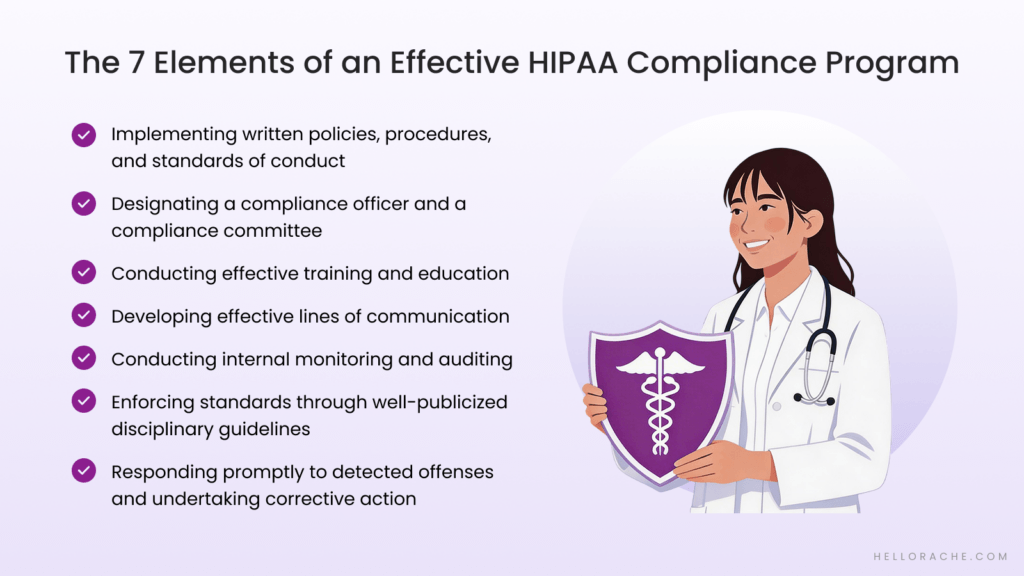
The HHS Office of Inspector General (OIG) created the Seven Elements framework as the baseline for any effective compliance program. These aren’t just recommendations. During audits, the OCR compares your program against them.
The Seven Elements are:
- Implementing written policies, procedures, and standards of conduct
- Designating a compliance officer and a compliance committee
- Conducting effective training and education
- Developing effective lines of communication
- Conducting internal monitoring and auditing
- Enforcing standards through well-publicized disciplinary guidelines
- Responding promptly to detected offenses and undertaking corrective action
At first, this can feel like a set of bureaucratic checkboxes. In practice, it works more like a management framework for running a safe, consistent operation.
Most small to mid-sized practices already do parts of this. They train staff, communicate expectations, and address issues as they arise. What is often missing is structure and consistency.
When entities document and apply these actions consistently, they become a reliable compliance system rather than a reactive process. This kind of structure is often the key to success for HIPAA compliance in real-world settings.
HIPAA Violations: Penalties, Tiers, and Real-World Consequences
HIPAA violations are enforced by the Office for Civil Rights (OCR). Not all violations are treated the same. Penalties depend on intent, awareness, and whether the issue was corrected.
The Four Penalty Tiers
Violations fall into four tiers:
| Tier` | Description | Penalty Range |
|---|---|---|
| Tier I: Unknowing | Entity was unaware of the violation | $145–$36,505.50 per violation |
| Tier II: Reasonable Cause | Should have known, no willful neglect | $1,461–$73,011 per violation |
| Tier III: Willful Neglect (Corrected) | Willful neglect, corrected within 30 days | $14,602–$73,011 per violation |
| Tier IV: Willful Neglect (Uncorrected) | Willful neglect, not corrected | $73,011–$2,190,294 |
Data Source: HIPAA Journal
Fines vary based on severity and intent. They can range from a few hundred dollars per violation to over $60,000. In serious cases, total penalties can exceed $2 million per year.
But financial penalties are only part of the impact.
Investigations take time and disrupt daily operations. Practices may need to respond to audits, provide documentation, and adjust workflows under pressure. This can slow down staff and affect patient experience.
There is also reputational damage. Patients expect their medical team to handle their information with care. When something goes wrong, it’s difficult for people to trust the same business again.
Common HIPAA Violation Types
Most violations don’t come from complex attacks. They often come from everyday gaps in process or oversight.
Common examples include:
- Missing agreements: Failing to establish required agreements with vendors handling PHI.
- Failure to report breaches: Missing required timelines for notifying patients or OCR.
- Unauthorized access or disclosure: Staff accessing records without a valid reason.
- Weak safeguards: Inadequate administrative, physical, or technical protections.
- Lack of training: Staff not properly trained on HIPAA requirements.
These issues are preventable. But without structure and consistency, they happen more often than expected.
Recent HIPAA Updates in 2025 and 2026
New tools, workflows, and risks push regulators to update how compliance should work in practice.
Over the past few years, enforcement has also become more focused. It’s no longer just about having policies in place. It’s about how quickly you respond, how securely you use technology, and how well your systems hold up under pressure.
Here are the key updates to pay attention to:
- HIPAA Security Rule updates (2025): HHS proposed stricter requirements around encryption, multi-factor authentication, and faster incident response timelines. These changes aim to reduce gaps in technical safeguards. Since this is still in the rulemaking process, practices should verify the current status and prepare for updates.
- AI and ePHI: AI tools, including medical scribes, are becoming part of daily workflows. OCR has started clarifying how these vendors fit into compliance. If an AI tool handles electronic protected health information, it must follow the same rules as any other partner.
- Telehealth and PHI considerations: The post-pandemic era has normalized telehealth use. But not all tools meet HIPAA requirements. Review video platforms, messaging apps, and file-sharing tools. If they lack proper security controls, they can expose patient data.
- OCR Right of Access Initiative (ongoing): The OCR continues to enforce patients’ rights to access their records quickly. Delays, incomplete responses, or complicated processes can trigger investigations. This remains one of the most common areas of enforcement.
How Virtual Medical Assistants Fit Into HIPAA Compliance
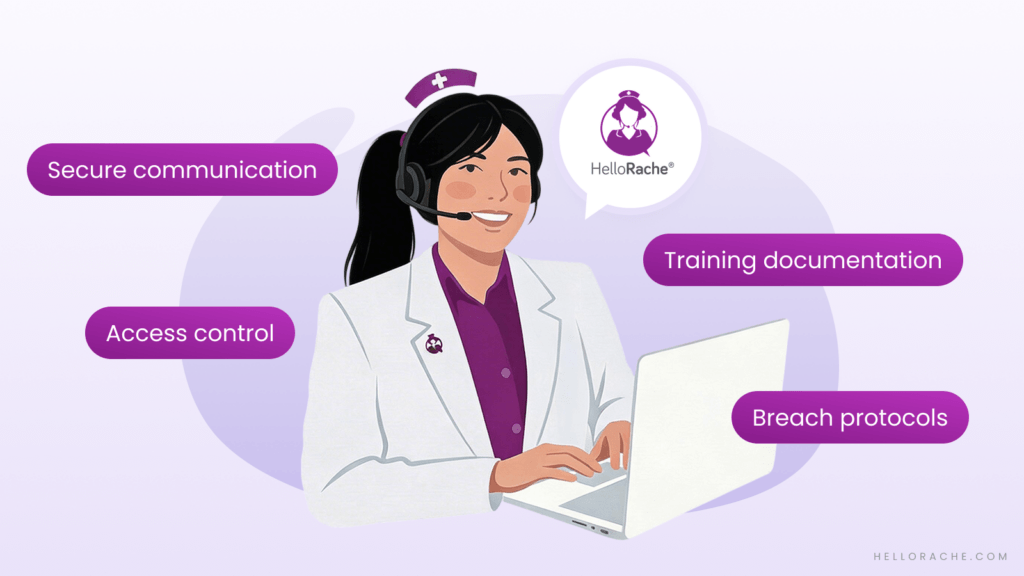
When you bring in outside help, the rules don’t change. If that person can access patient data, they’re subject to HIPAA. This includes virtual medical assistants.
In HIPAA terms, they’re business associates. That means you’re still responsible for how they handle PHI.
This is where many practices underestimate the risk. Remote support often spans systems, messaging, and daily workflows. If access isn’t clearly defined, someone can expose sensitive data without any of the staff noticing right away.
Working with HIPAA-compliant medical assistants requires a clear structure. Without it, small gaps can turn into real risks.
Here are the key areas to get right:
- Secure communication: Remote and in-person teams should never share protected health information through personal email or messaging apps. Use approved, secure channels only.
- Training documentation: Your remote staff should have HIPAA training documentation. This should be up to date and easy to verify.
- Access control: Give access based on role. Staff should only have access to what they need for that specific task.
- Breach protocols: There should be clear steps for what happens if something goes wrong.
It also helps to think about how these assistants fit into your workflow. They often support scheduling, patient communication, documentation, and record updates. Each of these tasks involves PHI, even if it seems routine.
Using remote support can help keep operations moving. But it only works if compliance is built into how work happens day to day.
At Hello Rache, our Healthcare Virtual Assistants® receive training in medical terminology and HIPAA-aware practices. Many come from clinical backgrounds, including registered nurses. That background shows in how they handle patient communication, documentation, and records.
Strengthening HIPAA Compliance in Healthcare Starts With Everyday Practice
HIPAA compliance in healthcare isn’t a form you file once and forget. It’s an ongoing commitment. It shows up in how your team handles data and how quickly they address issues.
You’re protecting the patients who trust you with sensitive information.
That said, it’s not easy to maintain. Physicians and office managers already juggle a lot. Adding compliance on top can feel overwhelming. But the structure is there to guide you.
You already have a roadmap:
- Clear documentation and consistent processes
- The Seven Elements of compliance programs
- The three core HIPAA rules
Most practices are already doing parts of this. The goal is to make it consistent, visible, and reliable.
If you’re reviewing workflows, evaluating virtual staff like healthcare assistants or medical receptionists, or checking your systems for gaps, support can make a difference. Hello Rache works with practices that take compliance seriously and need help maintaining it day-to-day.
Want to learn how Hello Rache’s Healthcare Virtual Assistants® can support your practice’s HIPAA compliance efforts?
Frequently Asked Questions About HIPAA Compliance in Healthcare
What Is the Difference Between the HIPAA Privacy Rule and the Security Rule?
The Privacy Rule focuses on what patient information can be used or shared, and when. It sets limits and gives patients rights, such as access to their records.
The Security Rule focuses on how electronic data is protected. It covers safeguards like access controls, encryption, and system security.
One sets the rules. The other protects the systems that follow them.
Does HIPAA Apply to Small Medical Practices?
Yes, it does. HIPAA applies to any provider that handles patient health information. It doesn’t matter how big your company is. Or how long you’ve been in business.
The difference is in how an organization applies safeguards. Smaller practices can scale their approach, but they still need to meet the same core requirements.
How Often Do Practices Need to Update Their HIPAA Compliance Program?
HIPAA doesn’t set a fixed update schedule. But in practice, updates should happen regularly.
You should review your program at least once a year. There’s also the need for updates when workflows change. Even when there are new tools or potential risks arise.
As you can see, compliance evolves with your practice.
What Happens During an OCR HIPAA Audit?
An OCR audit reviews how well your practice follows HIPAA rules. It usually starts with a document request. They review policies, training records, and risk analyses first.
If they notice gaps, investigators may ask for more details. In serious cases, this can lead to corrective action plans or penalties. Clear documentation and consistent processes make audits much easier to manage.