AI could reduce U.S. healthcare spending by 5% to 10%, according to the National Bureau of Economic Research. That’s roughly $200 billion to $360 billion per year.
However, its rapid adoption is also raising concerns beyond mere savings.
AI in healthcare refers to technologies like machine learning (ML) and natural language processing (NLP) that:
- Automate time-consuming tasks
- Detect disease patterns
- Analyze medical data
Broader access to patient care and faster diagnosis are part of the benefits.
It also carries risks around data security, algorithmic bias, and accountability.
This post explores the pros and cons of AI in healthcare. We explore where the technology delivers measurable benefits, where it still falls short, and what responsible implementation looks like in practice.
Highlights
- The pros and cons of AI in healthcare include real trade-offs, like better outcomes and cost savings on one side, serious data security and algorithmic bias risks on the other
- No single regulatory framework governs AI in U.S. healthcare today, making compliance a moving target for providers and vendors alike
- Machine learning and predictive analytics are already helping providers catch disease earlier and allocate resources more efficiently
What Is Artificial Intelligence (AI) in Healthcare?
Artificial intelligence is a set of technologies that healthcare organizations use to assess medical data, support clinical decision-making, and automate routine tasks.
Definition of AI in Healthcare
AI is a computer system that lets machines perform tasks that normally require human-level intelligence. This includes learning, problem-solving, and decision-making.
In healthcare, AI isn’t a single tool. It includes different systems that support clinical and operational work. For example, AI software can:
- Analyze medical images, like CT scans
- Flag a deteriorating patient
- Draft a clinical note
Together, these technologies support:
- Administrative workflows
- Treatment decisions
- Medical research
- Diagnosis
Key AI Technologies Used in Healthcare
Different technologies fall under the AI umbrella. Each one has a different purpose in healthcare.
- Natural language processing (NLP): It interprets clinical notes, electronic health records (EHRs), and patient communications.
- Generative AI/LLMs: It drafts clinical documentation, answers patient queries, and supports clinical decision-making.
- Computer vision: It analyzes medical images, such as X-rays, MRIs, and CT scans, for abnormalities.
- Deep learning: It specializes in complex pattern recognition in imaging and genomics.
- Machine learning (ML): It learns from patient data to improve predictions over time.
How AI Fits Into the Healthcare Ecosystem
Think of AI in healthcare as a pipeline. Data enters the system from EHR software, wearable devices, and medical imaging tools. Then, algorithms process that information. The result might be:
- A treatment recommendation
- An automated billing code
- A diagnostic suggestion
This data is very sensitive. Make sure to implement strict safeguards.
This includes HIPAA and security frameworks like HITRUST. These govern how you collect, store, and use healthcare data. Any AI technology operating in healthcare must function within these frameworks.
The Pros of AI in Healthcare
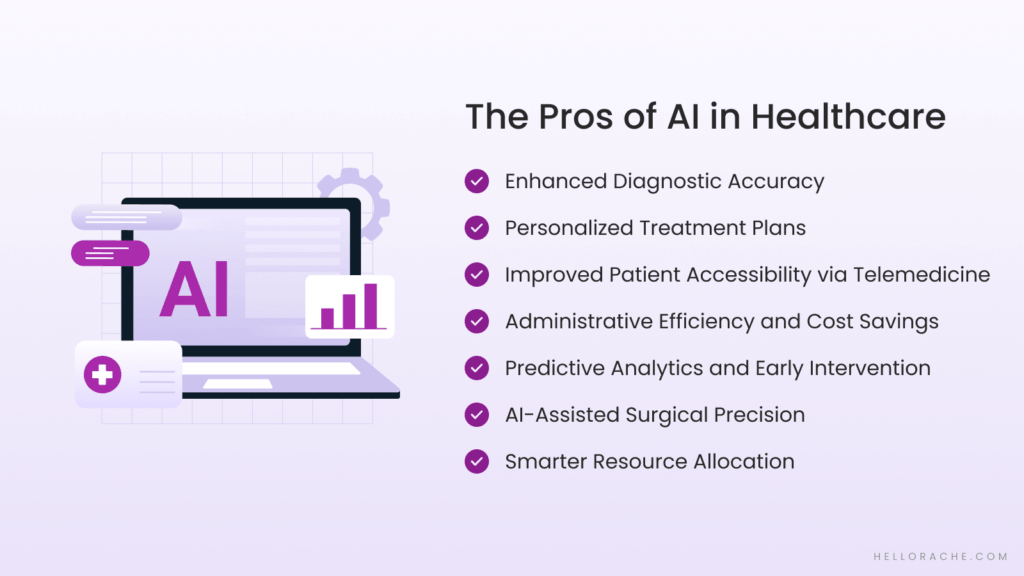
In healthcare, AI is already changing how providers diagnose, treat, and manage patients. And the results are hard to ignore.
Pro #1: Enhanced Diagnostic Accuracy
AI-powered algorithms can analyze X-rays, MRIs, and CT scans. They spot details that even experienced clinicians may miss. That can improve the detection of cancer, fractures, and cardiovascular disease.
A study published in PLoS One shows how significant that improvement can be.
When AI-assisted radiologists double-read CT scans for rib fractures, diagnostic sensitivity rose from 69% to 94%. However, specificity stayed perfect.
That level of accuracy matters. Catching a missed fracture sooner can change a patient’s outcome. ML models pick up subtle diagnostic patterns that routine human review may overlook, especially when the data volume is high.
Pro #2: Personalized Treatment Plans
Every patient responds differently to treatment. AI helps physicians move away from the old one-size-fits-all model. AI systems don’t rely only on symptoms or short consultations. They look at large sets of patient data.
This can include:
- Lifestyle information
- Genetic profiles
- Clinical records
The result is a more individualized care plan built around the patient’s specific risk factors and health patterns.
Precision medicine has shown a strong impact in oncology. AI models help physicians identify which therapies are more likely to work for certain cancer patients.
The same approach applies to other areas of health. This includes chronic disease management and mental health care. By analyzing patterns across many patients, AI helps clinicians adjust treatments earlier and with more confidence.
Pro #3: Improved Patient Accessibility via Telemedicine
AI is also expanding access to care through telemedicine. Wearable devices and connected sensors collect real-time health data from patients throughout the day.
Doctors can see what’s happening between visits. This is especially helpful for people managing long-term conditions. Many patients can speak with a doctor remotely instead of traveling long distances to a clinic.
A study in the Healthcare journal found that AI-driven telehealth platforms significantly increase access to care in rural and underserved communities. Specialists who were once hours away are now reachable.
AI-based triage systems guide patients toward the right level of care before they even speak to a clinician. It helps prioritize urgent cases and reduces unnecessary visits.
Pro #4: Administrative Efficiency and Cost Savings
Administrative work consumes a surprising amount of clinical time.
- Processing insurance claims
- Scheduling appointments
- Managing billing
These often pull providers away from patient care.
AI tools help automate many of these tasks. Documentation, coding, scheduling, and prior authorizations can now be handled with far less manual input. That frees doctors to spend more time with patients.
In fact, the 2025 CAQH Index reports that electronic transactions supported by automation generated $258 billion in administrative cost avoidance in 2024. This is a 17% increase from 2023.
Secure infrastructure also plays a role. Many healthcare systems now rely on HIPAA-compliant platforms and HITRUST-certified environments. These allow faster access to electronic medical records without compromising patient data security.
Pro #5: Predictive Analytics and Early Intervention
Predictive analytics helps physicians stay ahead of problems instead of reacting to them. AI models process health records, environmental data, and patient history. From there, they can flag patients who may deteriorate before symptoms become severe.
That early warning matters.
It can reduce hospital readmissions and help clinicians adjust treatment plans sooner. It also prevents complications in the management of chronic diseases.
Predictive tools also support population health programs. Healthcare systems can identify patients who are most likely to need additional support. Instead of reacting to crises, physicians can focus on prevention and early treatment.
Pro #6: AI-Assisted Surgical Precision
The global robotic surgery market sat at $13.79 billion in 2025, according to Towards Healthcare. This is projected to reach $63.73 billion by 2035.
Robotic systems assist surgeons by stabilizing instrument movement, enhancing visualization, and delivering real-time feedback during procedures.
These tools can improve precision during delicate operations. In many cases, this supports less invasive surgical techniques.
Evidence suggests meaningful clinical benefits. One meta-analysis in the Journal of Robot Surgery found a 25% reduction in operating time. And a 30% drop in complications compared to manual techniques.
Also, some hospitals are using robotic technology in cardiac and thoracic surgery. Procedures include mitral valve repair and coronary artery bypass.
Pro #7: Smarter Resource Allocation
In hospitals, healthcare professionals experience constant pressure to manage limited resources, like:
- Inefficient supply chains
- Staffing gaps
- Unused beds
These can quickly disrupt patient care.
AI helps fix that. Predictive scheduling and supply chain tools reduce waste and keep care running consistently. McKinsey & Company research found that hospital employees spend around 20% to 30% of their day on nonproductive administrative tasks. AI-enabled scheduling systems could increase hospital occupancy rates by 10% to 15%.
This improves efficiency, productivity, and staff satisfaction.
The Cons of AI in Healthcare
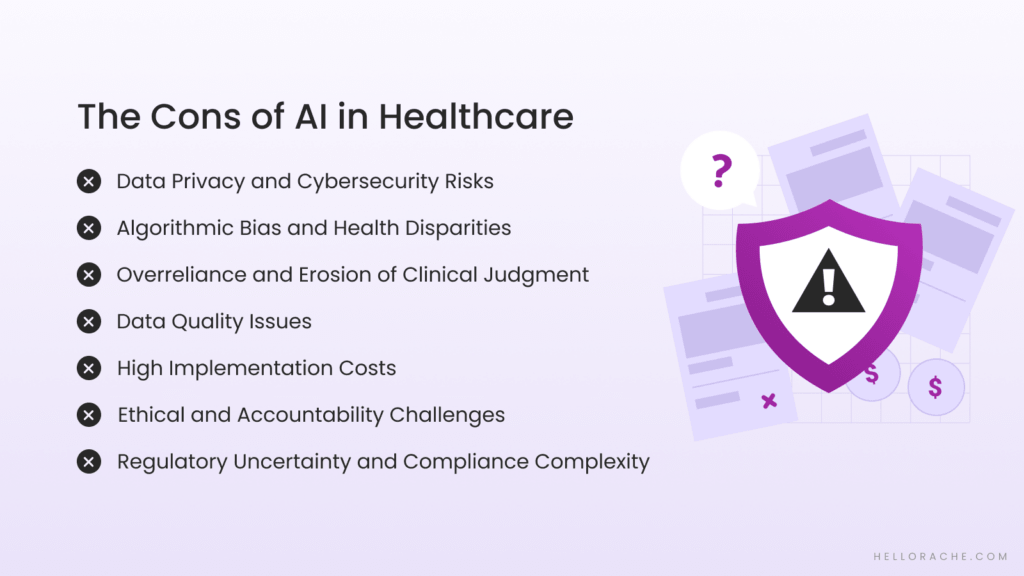
AI offers many benefits in healthcare. But it also introduces risks that organizations cannot ignore. Understanding these challenges is essential before adopting any AI-driven system.
Con #1: Data Privacy and Cybersecurity Risks
AI systems function on large volumes of data. Much of that information is highly sensitive patient data. This makes healthcare institutions attractive targets for cyberattacks.
The 2024 Change Healthcare ransomware attack exposed 190 million patient records, according to data by the American Hospital Association.
Healthcare systems face constant threats, including:
- Unauthorized access attempts
- Data breaches
- Ransomware
- Phishing
- Malware
AI platforms rely on interconnected digital systems. This means they can increase the number of entry points for attackers. That makes strong cybersecurity practices essential from the start.
GDPR and HIPAA set the compliance floor. But AI systems don’t automatically meet those standards. It’s important to build strong security practices into every stage of development and deployment.
The financial impact is significant. IBM research reports that the global average cost of a data breach is $4.4 million.
Con #2: Algorithmic Bias and Health Disparities
AI learns from historical data. The problem is that healthcare data often reflects decades of unequal treatment, unequal access, and unequal outcomes.
When biased data trains an algorithm, those patterns can appear in its predictions. That means some groups may receive less accurate diagnoses or treatment recommendations.
A study by Andrés Morales-Forero et al. on AI-based skin cancer detection found that classifiers achieved a precision of 0.897 for lighter skin tones. But only 0.484 for darker skin tones.
A separate study by Citizen found Black patients were 67% more likely to experience occult hypoxemia compared to White patients when AI-assisted pulse oximetry tools were used.
Without deliberate efforts to diversify data, AI may worsen existing health disparities. Patients who already face barriers to care may receive the least reliable algorithmic predictions.
Con #3: Overreliance and Erosion of Clinical Judgment
AI can support clinicians, but it cannot replace clinical judgment, and overreliance creates risks.
A study by Jingshu Li et al. found that when users felt overly confident in AI outputs, they were more likely to follow its recommendations, even when those recommendations were wrong.
A BMJ report also warns about deskilling: when students and clinicians rely less on independent reasoning, that ability can fade.
Medicine depends on judgment, patient history, social context, subtle clinical cues, and empathy. AI cannot fully account for all of that, so human oversight is still critical in diagnosis and treatment.
To ease admin strain, some practices hire remote medical assistants or virtual receptionists to handle coordination, calls, and scheduling so clinicians can stay focused on care.
Con #4: Data Quality Issues
AI systems depend on reliable data. When that data is incomplete, biased, or outdated, you get poor results.
Healthcare data is often scattered across different EHR systems. That creates interoperability gaps. Missing fields and inconsistent documentation make things worse.
These gaps make it harder for AI models to generate accurate predictions. Even powerful algorithms cannot fix a poor data infrastructure.
In healthcare analytics, the old rule still applies: Garbage in, garbage out. That means if you provide an AI system with incomplete patient histories or outdated entries, it will produce bad results. The model works with what it’s given.
Con #5: High Implementation Costs
Adopting AI technology requires significant investment. Healthcare organizations must:
- Integrate software with existing systems
- Maintain the technology over time
- Purchase new infrastructure
- Train staff
Large hospital systems may have the resources to do this. Smaller clinics and safety-net hospitals often don’t. That creates a real problem.
The providers serving vulnerable populations may struggle to access the same tools available to well-funded institutions. Over time, that gap can widen the digital divide across healthcare systems.
Con #6: Ethical and Accountability Challenges
When AI gets a diagnosis wrong, who’s responsible? The developer? The hospital? The clinician?
A 2023 study published in Frontiers in Medicine suggests that physicians typically assume full liability when AI serves as an assistive tool. This places providers in a difficult position.
AI recommendations can also conflict with patient values or family preferences.
Another challenge is transparency. Many systems operate as “black boxes.” This makes it difficult for doctors to explain how a recommendation was generated.
Patients have concerns as well. Questions about data ownership, consent, and the role of AI in medical decision-making remain largely unresolved.
Con #7: Regulatory Uncertainty and Compliance Complexity
As of 2025, the United States doesn’t have a single comprehensive law governing AI in healthcare.
Instead, organizations must navigate multiple frameworks. These include:
- The NIST AI Risk Management Framework
- International rules like the EU AI Act
- FDA guidance on AI and ML
- HIPAA
This regulatory landscape slows adoption. It also creates legal uncertainty for both healthcare providers and technology vendors.
New frameworks are emerging. The HITRUST AI Assurance Program and HITRUST CSF v11.2 aim to strengthen security and compliance standards, though regulatory clarity is still evolving.
Pros and Cons of AI in Healthcare at a Glance
The table below summarizes the advantages and disadvantages of AI in healthcare covered in this guide.
| Pros and Cons of AI in Healthcare | |
| Pros | Cons |
| Enhanced diagnostic accuracy | Cybersecurity and data breach risks |
| Personalized treatment plans | Overreliance and weakened clinical judgment |
| Improved telemedicine access | Data quality and EHR fragmentation |
| Administrative cost savings | High implementation costs |
| Predictive analytics and early intervention | Algorithmic bias and health disparities |
| AI-assisted surgical precision | Regulatory uncertainty |
| Smarter resource allocation | Ethical and accountability challenges |
How To Responsibly Implement AI in Healthcare
If, as a healthcare provider, you’re considering using AI, remember that this requires careful planning. Organizations that implement it successfully rely on:
- Structured risk management processes
- Strong governance frameworks
- Clear oversight
These ensure that the tools improve care without introducing new safety or compliance risks.
Key Risk Mitigation Strategies
Healthcare practices can reduce AI risks by putting the right safeguards in place.
- Adopt recognized governance frameworks: Standards such as HITRUST CSF, the NIST AI Risk Management Framework, and ISO 42001 offer guidance for managing AI security, privacy, and accountability.
- Work with certified cloud providers: Platforms such as AWS, Microsoft, and Google participate in the HITRUST AI Assurance Program. This signals strong security practices and responsible data handling.
- Ensure HIPAA compliance and independent audits: AI systems that handle patient data must meet HIPAA requirements. Regular third-party security assessments also help identify risks early.
- Use diverse training datasets: AI models learn from historical data. When that data reflects a wider range of patient populations, predictions tend to be more accurate and less biased.
- Monitor systems continuously: AI models can change over time as new data enters the system. Regular monitoring helps detect errors, bias, or declining performance.
- Maintain human oversight: AI should support, not replace, clinical judgment. Physicians must remain responsible for final decisions about patient care.
- Train healthcare staff: Providers should understand both the capabilities and limits of AI systems before using them in real clinical settings.
- Be transparent with patients: Organizations should clearly explain when AI tools assist with care and obtain consent.
The Future of AI in Healthcare Depends on Balance
AI in healthcare offers something genuinely powerful.
- Less time buried in paperwork
- Earlier interventions
- Faster diagnoses
- Broader access
The potential is real. But only if you use the technology responsibly, while having secure and ethical practices in place.
The pros and cons of AI in healthcare aren’t abstract ideas. They affect real patients, clinicians, and health systems every day. AI can help detect disease earlier and connect patients with specialists faster.
But poorly designed systems can also create problems:
- Recommendations that providers struggle to explain
- Biased predictions
- Privacy breaches
As AI evolves, healthcare organizations need to stay focused on responsible adoption.
Frameworks like HITRUST and the NIST AI Risk Management Framework help guide this process. Clear oversight also matters. It ensures new AI tools remain safe, transparent, and trustworthy.
Technology will keep moving forward. The question is whether healthcare institutions adopt it thoughtfully.
With the right safeguards, AI could become medicine’s greatest ally instead of its most complex liability.
Technology may change how healthcare operates. But clinicians still need reliable operational support. Hello Rache’s Healthcare Virtual Assistants® help manage EHR documentation, coordinate remote visits, and handle digital workflows so physicians can focus on patient care.
FAQs About AI in Healthcare
Is AI Replacing Doctors in Healthcare?
No. The goal of using AI is to enhance clinical expertise, not replace it. AI tools can analyze large datasets, detect patterns, and flag anomalies. Much faster than a human can.
But final medical decisions still require human expertise. Doctors rely on training, experience, and patient context. AI can assist with insights, but final judgment must remain with the clinician.
How Does AI in Healthcare Affect Patient Privacy?
AI systems need large amounts of patient data to work effectively. This often includes:
- Electronic health records
- Medical histories
- Imaging data
Because this information is sensitive, privacy protections are essential.
In the United States, HIPAA sets the baseline for protecting health data. In many international contexts, GDPR also applies. Additional frameworks, such as the HITRUST AI Assurance Program, provide stronger guidance for securing patient data in AI-driven healthcare environments.
What Regulations Govern AI Use in Healthcare?
There isn’t a single law that governs AI in healthcare today.
Currently, organizations must follow a mix of existing frameworks, like the:
- NIST AI Risk Management Framework
- FDA guidance on AI and ML
- HIPAA
Healthcare organizations operating internationally may also need to comply with the EU AI Act.
Industry programs, such as the HITRUST AI Assurance Program, are emerging to help healthcare organizations implement AI securely as regulatory standards continue to develop.