

As your medical practice grows, you need to handle more calls without overloading your staff. You want a reliable system that helps patients quickly, without making them wait on hold or forcing you to hire a complete call center. This matters because clear, friendly patient communication builds trust and supports better care.
That’s where the medical virtual receptionist vs. answering service decision comes in. The choice depends solely on your specific needs. Both options manage calls, but the similarity really ends there.
A medical virtual receptionist gives you full support for administrative tasks. An answering service usually takes messages. Knowing the difference helps you pick the right fit to improve your patient experience.
Highlights
- Medical virtual receptionists provide comprehensive support like appointment scheduling and EHR integration. Answering services usually just handle message-taking.
- The medical virtual receptionist vs. answering service decision comes down to one question. Do you need basic voicemail overflow or complete front-office support?
- Answering services cost less upfront. Virtual receptionists often deliver much better long-term value through efficiency and practice growth.
- For HIPAA compliance, choose support that handles complex patient inquiries. Medical virtual receptionists are the stronger choice.
- Virtual receptionists boost reputation with personalized service and thoughtful follow-ups that reduce no-shows.
What Is a Medical Virtual Receptionist
A medical virtual receptionist is a professional who manages your front desk remotely. They do more than answer phones. They handle booking appointments and answer procedure questions. They also verify insurance and assist with medical billing. They can handle prescription refills and manage referrals.
They don’t just screen calls. They build relationships with your patients. They can also guide future patients to choose a compatible doctor. This is a massive advantage for multi-doctor practices.
They do this within a secure technology infrastructure that connects right to your practice management software. A dedicated medical receptionist links directly with your electronic medical record (EMR) system. This allows them to access patient records and update information in real time.
They coordinate patient care just like staff in your office would. This ensures that absolutely nothing falls through the cracks during your busiest days. The only real difference is their physical location. They work remotely, often covering those late hours when your office is closed.
To fill this role effectively, Hello Rache offers Healthcare Virtual Assistants®. These team members arrive already knowing medical terminology and common clinical workflows.
By using smart follow-ups, they reduce cancellations and handle conversations that require actual medical knowledge. They can spot urgent issues to get patients to the right person immediately.
However, this model does have limitations:
- Medical virtual receptionists cannot greet walk-in patients or manage physical tasks
- A virtual receptionist requires a brief onboarding to learn your clinic’s protocols
- Their success relies on a stable internet connection and digital workflows
What Are Answering Services
An answering service acts like a safety net. It covers calls when your medical staff can’t get to the phone. This happens during lunch, after hours, or when things get busy.
Most answering services use operators to take notes. They write down the caller’s info and send it to you later, often acting as a glorified voicemail service. You get this info via text, email, or a daily call.
There are two primary types of answering services. Live operators offer a human voice and follow custom scripts. Automated systems use menus to route calls.
Pros of answering services include:
- Automated ones are upgradable with artificial intelligence for intelligent, helpful answers
- Emergencies get routed to on-call doctors
- Easy setup with a bit of tech work
- Usually, a toll-free number
- 24/7 coverage
- Low-cost
But they also have limitations:
- They don’t know your schedule well enough to book slots, unless you plug in an AI with access to your calendar
- Patients often realize they’re talking to an outsider, which can feel a bit awkward
- Answering services can’t answer complex patient inquiries
- They don’t actually solve the patient’s problem
- These services are reactive, not proactive
Key Differences Between and Benefits of Medical Virtual Receptionists and Answering Services
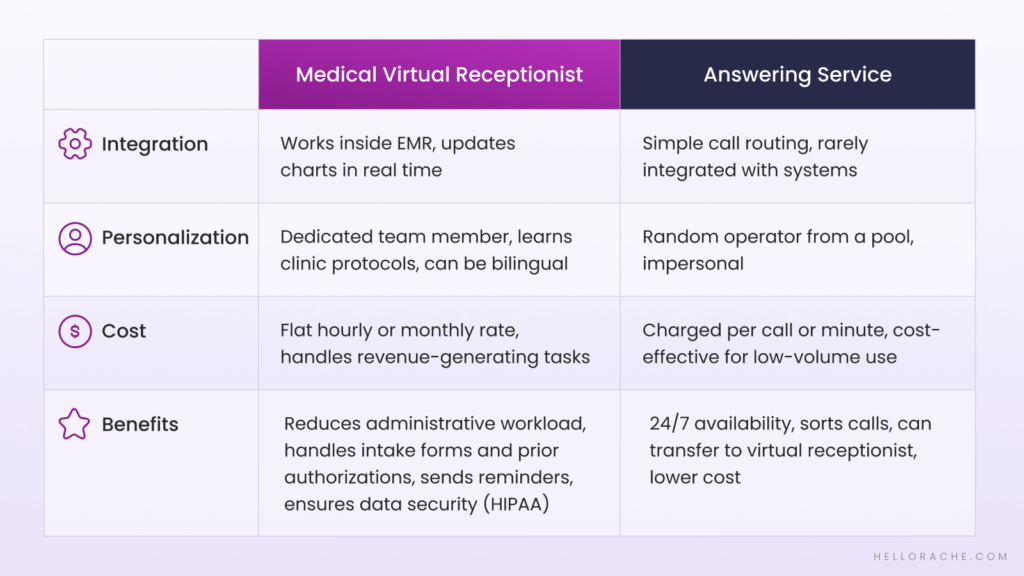
There are three key differences between medical virtual receptionists vs. answering services. Technology and integration, customization, and cost.
Technology and integration:
Answering services typically rely on simple tools like call routing and basic scripts. They rarely connect with your internal systems. In contrast, medical virtual receptionists work directly inside your practice management systems.
According to the American Medical Association, too many administrative tasks are the leading cause of doctor burnout. All this extra work takes up significant time away from patients. It also wears out providers who are already doing too much. You need a solution that actually reduces this workload rather than just pushing it to later.
Medical virtual receptionists help fix this because they function inside your EMR. They handle data entry and update charts in real time. They manage the digital paperwork that slows you down. A virtual front desk solution means someone handles these tasks all day so your clinical team can focus on patients.
Customization and Personalization:
Answering services use a pool of operators. A patient might speak to a different person every time, which can feel impersonal. Medical virtual receptionists offer a dedicated team member who learns your specific protocols.
This allows for tailored customer communication and even bilingual support if needed. They act as a true extension of your staff rather than an external vendor.
Cost Considerations:
Answering services often charge by the minute or by the call. This makes them cost-effective for low-volume use.
On the other hand, virtual receptionist pricing is usually at a flat hourly or monthly rate. While the initial price is higher, they handle revenue-generating tasks like booking appointments. This often provides better ROI than a service that just takes messages.
Benefits of Using a Medical Virtual Receptionist
Beyond the technical details, Hello Rache is different because you get a dedicated team member, not a random operator every time. This setup makes your practice run more smoothly. Your virtual staff member handles time-intensive tasks like prior authorizations and intake forms. This way, your in-house team can stay focused on what matters most: caring for patients.
This focused attention boosts satisfaction. Patients get answers fast, and appointment scheduling becomes seamless. This directly protects your revenue. According to a review in Health Science Reports, no-show rates in clinics can range from 12% to 42%.
Medical virtual receptionists actively fight this trend. They make live reminder calls and send personalized texts to confirm attendance. They also handle complex insurance verifications days before the visit. This proactively stops coverage surprises at the front desk and keeps your schedule full.
Data security is also a massive deal because breaches are expensive. According to the HIPAA Journal, healthcare data breaches cost an average of $9.77 million in 2024.
Hello Rache prioritizes patient data confidentiality. Unlike general agencies, we ensure every candidate is vigorously vetted and HIPAA-trained. You cannot afford to cut corners with patient health information, so it is essential to choose a partner who takes this seriously.
With professional virtual receptionist services, secure systems and compliance are built in. You work with the same virtual receptionist every day. This makes them feel like part of your team, and patients hear a familiar, trusted voice.
Benefits of Using an Answering Service
Answering services fill a specific need for specific situations. The 24/7 availability is excellent for after-hours routing.
They also help sort calls. They can redirect customers or instruct them to leave a recording for a prescription. They can even transfer them to a virtual receptionist if you go with both solutions.
Finally, there’s a lower cost. This is a definite plus for new practices, as they don’t have to hire more staff yet.
Challenges To Consider Between Medical Virtual Receptionist vs. Answering Service
Tech needs differ for each option. Medical virtual receptionists need good internet and software access. If your EMRs are old, integration might be complex. Answering services are simpler but offer less tech help.
Privacy rules like HIPAA also need constant attention. You must ensure that any provider trains their team well and signs a business associate agreement with you.
Transitioning takes time, too, as any new team member needs a moment to adjust. Your virtual team needs to learn your ways, your patients, and your rules. A remote assistant comes trained, but they still need to learn your specific flow.
This onboarding effort pays off, but it takes more time than setting up a simple message service. You have to be ready to invest that initial time to get the best results.
How To Choose the Right Option for Your Practice
Making the medical virtual receptionist vs. answering service choice is easier when you have a partner you can trust.
Hello Rache makes the process of hiring a medical virtual receptionist simple. We handle the vetting, background checks, and initial training for you.
You don’t have to sift through resumes or worry about qualifications. You simply interview pre-selected candidates and pick the one who fits your team. This saves you weeks of time and ensures you get a pro who is ready to work.
When you’re ready to hire, assess your specific needs. Look at your practice size and available options. Then ask yourself:
- How do the features compare between providers?
- How does the budget compare to the full value?
- Do you need scheduling software support?
- Do you just need after-hours messages?
- Do you require bilingual staff?
When searching for the best virtual receptionist, seek feedback from current users to confirm they deliver on their promises.
Conclusion
The medical virtual receptionist vs. answering service decision depends on your goals. Answering services offer basic help at a lower cost, which works for simple messages. Medical virtual receptionists give you full office support. They integrate with your systems and boost patient happiness.
Most practices find that virtual receptionists offer better value. They improve flow and reduce administrative busywork. They help increase appointments and lower no-show rates. The investment leads to smoother days and happier patients.
As always, focus on solving your unique practice’s needs.
Ready to see how virtual receptionist services can change your practice?
FAQs
What Is the Difference Between a Medical Virtual Receptionist vs. Answering Service?
The medical virtual receptionist vs. answering service distinction comes down to capabilities. Receptionists handle complex clinical tasks like EMR entry. Answering services provide basic message-taking services.
Which Option Is More Cost-Effective for a Growing Medical Practice?
Answering services have lower monthly fees. Virtual receptionists deliver better ROI by reducing no-shows. They also improve revenue with insurance verification and referrals.
How Quickly Can I Get Started With a Hello Rache Virtual Receptionist?
We make it simple to start immediately. Schedule a consultation to discuss your needs. Hello Rache will connect you with pre-vetted, HIPAA-compliant candidates ready to join your team.