

Optometry medical billing is where many practices lose revenue without realizing it. Claim denials stay high, even when patient care is excellent. The issue often isn’t obvious. It shows up in small ways:
- Sending claims to the wrong insurance plan
- Missing a modifier during claim submission
- Undercoding
At the same time, demand for eye care continues to grow. Over 3.4 million adults aged 40 and older in the U.S. live with vision impairment or blindness, according to the CDC. More patients mean more insurance claims. And more room for preventable billing mistakes.
The year 2026 brings:
- Updated CMS conversion factors
- Stricter NCCI edits
- New CPT codes
These all raise the bar for clean optometry billing.
In this guide, you’ll learn how optometry billing and coding really work. We’ll walk through key codes, how to route between vision and medical insurance, common causes of claim denials, and how the right support can protect your revenue.
Highlights
- Most claim denials in optometric billing come from preventable issues like wrong insurance routing, missing modifiers, or weak documentation
- Strong revenue cycle management and tracking of denied claims can quickly improve financial performance
- Knowing when to bill vision vs. medical insurance is critical for accurate reimbursement rates
- Dedicated billing support helps maintain accuracy without slowing down patient care
What Is Optometry Medical Billing?
Optometry medical billing is the process of coding, submitting, and collecting payment from medical insurance for services that diagnose or treat eye conditions. It connects clinical care with insurance claims, ensuring your practice receives timely payment for medically necessary services.
In optometric billing, it’s important to evaluate every visit. Practices work within a dual system.
A vision plan covers:
- Routine eye exams
- Refraction tests
- Contact lenses
Medical insurance applies when the visit involves a disease, injury, or medically necessary diagnostic tests, such as optical coherence tomography (OCT).
This distinction is critical. Billing the wrong payer is one of the most common and preventable causes of claim denials. It often happens before you even submit a claim.
A clean medical billing and coding process follows a clear flow:
- Insurance eligibility: Confirm coverage and payer type.
- Exam documentation: Record symptoms, findings, and medical necessity.
- Code assignment: Apply correct CPT and ICD-10 codes.
- Claim submission: Send accurate insurance claims.
- Denial management: Review and resolve denied claims.
- Payment posting: Update accounts receivable.
Vision Insurance vs. Medical Insurance: Knowing Which to Bill
First, you need to evaluate the patient visit. Why is the patient here today?
The answer determines which payer you bill. If you send the claim to the wrong provider, it will likely be delayed or denied.
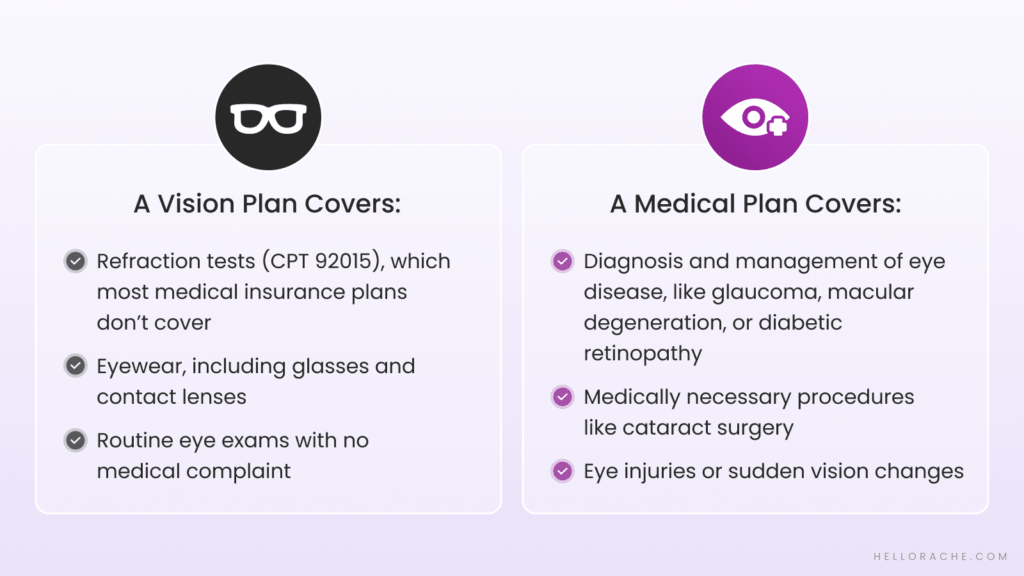
For example, a vision plan covers routine care. It includes:
- Refraction tests (CPT 92015), which most medical insurance plans don’t cover
- Eyewear, including glasses and contact lenses
- Routine eye exams with no medical complaint
Medical insurance applies when there’s a clinical reason for the visit. It includes:
- Diagnosis and management of eye disease, like glaucoma, macular degeneration, or diabetic retinopathy
- Medically necessary procedures like cataract surgery
- Eye injuries or sudden vision changes
Many patients have both types of coverage. That’s where confusion starts. The key factor is medical necessity. If the primary diagnosis is medical, and your documentation supports it, the claim should go to medical payers.
One small step helps avoid most mistakes. Always verify insurance eligibility before the visit. Flag the visit type early. It improves claim submission accuracy and protects your reimbursement rates.
Key CPT Codes Every Optometry Practice Should Know
Accurate CPT codes are essential in optometry billing. Incorrect codes raise claim risk. Knowing key codes reduces errors and safeguards reimbursement.
Eye Exam and E/M Codes
These are the most frequently used billing codes. They apply to both routine and medical visits, depending on the reason for care.
- CPT 92002–92014: These refer to Intermediate and comprehensive eye exams for new and established patients. These are the most commonly billed optometry codes.
- CPT 99202–99215: These are evaluation and management codes used for medical visits. These apply when diagnosing or managing conditions like glaucoma or diabetic eye disease.
- Refraction (CPT 92015): Refraction tests are usually not covered by medical insurance. Coding companies bill these separately. Patients are typically responsible for this cost, so communicate clearly before the visit.
Diagnostic and Imaging Codes
Diagnostic testing supports clinical decisions, but it must be tied to medical necessity in your documentation.
- CPT 92134 (OCT): Optical coherence tomography is frequently billed but increasingly scrutinized for over-utilization without clinical justification.
- CPT 92250: This refers to fundus photography, which documents retinal conditions. Under NCCI edits, billing providers may bundle it with OCT unless both services are independently documented.
- CPT 92288 (new in 2026): This refers to dark adaptation screening, a new CPT code for practices offering advanced diagnostic testing.
- CPT 92284 (revised in 2026):It’s an updated descriptor for diagnostic dark adaptation exams like rod and cone sensitivities. This is different from screening code 92288.
Here’s a key 2026 update that affects remote care. Expanded codes, such as CPT 99445 and 99470, now allow billing for shorter monitoring periods. This is useful for practices using tele-ophthalmology tools.
Before submitting any insurance claim, confirm your system reflects the latest coding changes. An outdated setup can quietly lead to rejected or delayed claims.
How to Use Modifiers Correctly in Optometry Billing
Modifiers can change how a claim is paid. In optometry, using them correctly helps demonstrate that services are separate, necessary, and correctly coded.
Modifier -25: Separate E/M Services
Use modifier 25 when a significant, separately identifiable E/M service happens on the same day as another procedure. It tells the payer that the visit involved more work than the procedure alone.
Think of it this way. The exam wasn’t just routine. You evaluated a problem, made decisions, and provided care beyond the standard service.
Here’s a common example. A patient comes in for a comprehensive eye exam (CPT 92014). During the visit, you also evaluate and treat an eye infection using CPT 99213. You would append modifier 25 to the E/M code.
The key is documentation. You need to show that these were two distinct services. In 2026, payers are reviewing modifier 25 more closely. If notes are unclear, they may downcode or deny the claim.
Modifier -59: Distinct Procedural Service
Use modifier 59 when a procedure is separate from another service performed on the same day. This often comes up in optometric billing for imaging.
For example, if you perform fundus photography and an OCT on the same visit, you may need modifier 59 to show they were distinct and medically necessary.
Keep in mind, NCCI edits change often. Review them every quarter. Many practices keep a list of commonly denied code pairs and check them regularly.
In 2026, the Centers for Medicare & Medicaid Services (CMS) removed some procedure-to-procedure edits involving CPT 92137 and certain angiography codes. That’s a good reminder that NCCI review is essential.
The Most Common Optometry Billing Denials (and How to Prevent Them)
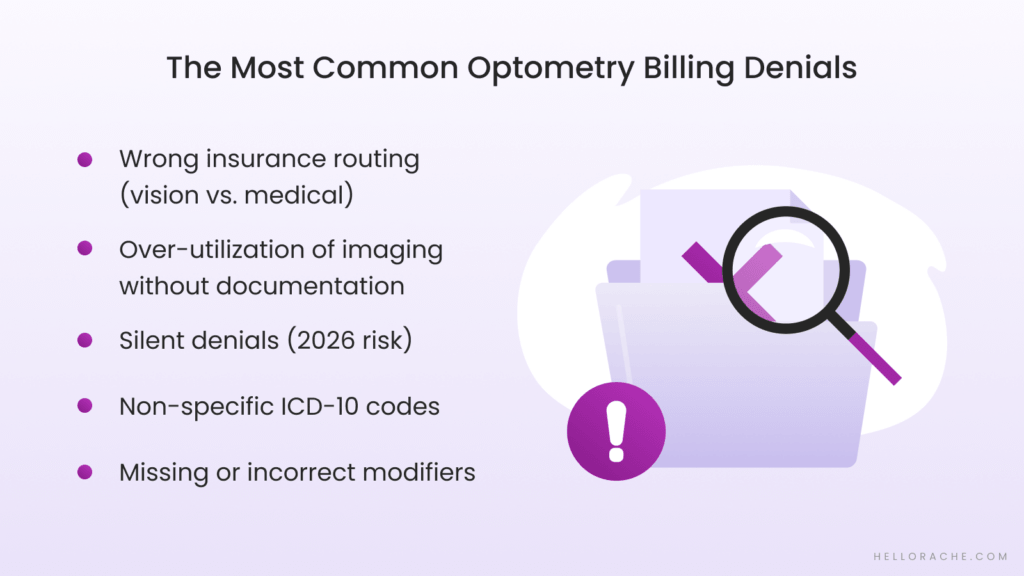
Most claim denials are predictable. In fact, Rivet Health reports that 82% to 92% of claim denials are avoidable with stronger revenue cycle management. That means the issue is rarely the payer. It’s usually something small in the workflow.
Here are the most common causes in optometry medical billing, and how to prevent them:
- Wrong insurance routing (vision vs. medical): This often starts at the front desk. If the visit is sent to the wrong payer, the claim will fail. Always verify insurance eligibility before the visit. Train staff to distinguish between routine and medical visits.
- Over-utilization of imaging without documentation: Billing for OCT scans or fundus photography without clear medical necessity raises red flags. Payers now use automated systems to flag overuse. Your notes must explain why the patient needed the test and how it affects care.
- Silent denials (2026 risk): These are harder to catch. The claim isn’t rejected, but payment is reduced or missing. This often happens due to frequency limits or bundling rules. Track test history by eye and monitor the Explanation of Benefits (EOB) carefully.
- Non-specific ICD-10 codes: Vague diagnosis codes trigger rejections. Always code to the highest level of specificity. Include laterality, such as the left eye, right eye, or bilateral. Missing this detail is a common reason for denied claims.
- Missing or incorrect modifiers: Errors with modifier 25 or 59 can lead to denials or reduced payment. Build a checklist into your billing and coding workflow. Also, review documentation before submitting any claim with modifiers.
Catching these issues early makes a real difference. A trained billing professional working inside your EHR can spot problems before claim submission. This is exactly how a Healthcare Virtual Assistant® from Hello Rache supports optometry billing workflows.
Best Practices for Optometry Medical Billing in 2026
Here are some practices you can implement for a successful medical billing process:
- Pre-visit workflow: Start before the patient arrives. Verify insurance eligibility and confirm the payer type. Ask why the patient is coming in. This helps determine whether the visit is covered by medical or vision insurance early and avoids routing errors.
- Documentation standards: Every service must be backed by clear notes. Avoid vague phrases like “routine follow-up” when a procedure is performed. For E/M visits, show your medical decision-making. Weak documentation leads to claim denials.
- Stay current on 2026 updates: Coding rules keep changing. The 2026 CPT codes set added 288 new codes. CMS also set conversion factors at $33.57 for qualifying APM participants and $33.40 for non-qualifying APM participants. Always check payer-specific adjustments.
- Batch NCCI review into quarterly workflows: NCCI Edits change often. Assign someone to review updates each quarter. Keep a list of denied code pairs and update it regularly. This prevents repeat mistakes.
- Denial tracking: Don’t just fix denials. Track them. Look at trends by payer, code, and reason. If your denial rate is above 5%, there’s likely a system issue in your revenue cycle management.
- Consider administrative support: Keeping billing accurate while managing patients isn’t easy. Many optometric practices rely on trained support, including a remote assistant to handle claim review, follow-ups, and documentation checks.
If you’re looking to outsource your medical billing, Hello Rache provides virtual optometrist assistants for eye care clinics. They’re trained in optometry billing and coding, understand payer rules, and follow your existing workflows.
Protect Your Revenue Without Slowing Down Patient Care
An effective optometry medical billing process comes down to a few core habits. When these are in place, your insurance claims move faster and with fewer issues.
- Route claims correctly: Know when to bill vision versus medical insurance.
- Use accurate codes and modifiers: Support every CPT code and modifier with clear documentation.
- Stay current: Keep up with 2026 coding changes and NCCI edits.
These steps sound simple, but they require consistency. Billing accuracy isn’t something you fix once. It actually should be part of your daily workflow.
And that’s where many practices feel the strain. You’re managing patients, staff, and operations at the same time. Billing often gets pushed aside.
This is where dedicated support helps. Healthcare Virtual Assistants® from Hello Rache work within your EMR or EHR software. They review documentation, support claim submission, and help reduce claim denials.
Ready to streamline your optometry billing process? SCHEDULE A CONSULTATION to discover how Hello Rache can help your practice maximize reimbursements and reduce denials.
Frequently Asked Questions About Optometry Medical Billing
What Is the Difference Between Vision and Medical Insurance in Optometry?
The difference comes down to why the patient is seeing an optometrist.
Vision insurance covers routine eye exams, refraction tests, and contact lenses. Medical insurance applies when there’s a clinical issue, such as eye disease, injury, or symptoms that require evaluation. In optometry medical billing, the diagnosis and documentation decide which payer to bill.
What CPT Codes Are Most Commonly Used in Optometry?
The most common CPT codes include 92002–92014 for eye exams and 99202–99215 for medical visits. Practices also frequently use 92134 for OCT scans and 92250 for fundus photography.
As for refraction (92015), practices or billing providers usually bill it separately as an out-of-pocket service.
How Can Optometry Practices Reduce Claim Denials?
Start with the basics. Verify insurance eligibility, use specific ICD-10 codes, and apply modifiers correctly. Make sure documentation supports every service billed. It also helps to track denied claims and fix patterns early.