A 2025 study of 263 physicians found burnout dropped from 51.9% to 38.8% after just 30 days of using an AI medical scribe. That kind of shift points to one core issue:
Documentation is still one of the biggest pressures in modern clinical work.
It’s not just about stress. Time is a bigger problem. According to the American Medical Association, physicians who use AI scribes save about one hour per day on charting and documentation. That’s time pulled back from late nights, or from the hours that should go to patient care.
The market has changed quickly. What used to be basic speech recognition tools are now full ambient clinical documentation systems. Today, AI medical scribe platforms can:
- Sync with the electronic health record in near real time
- Generate structured clinical notes
- Capture patient encounters
And there are more options too. Solo providers, growing practices, and large health systems can all find tools built for their workflows and budgets.
In this guide, we break down the nine best AI medical scribe services of 2026. We look at note quality, EHR integration, pricing, and practice fit so you can choose with confidence.
Highlights
- The best choice depends on your practice setup: Solo providers, specialty clinics, and enterprise systems all need different levels of automation, support, and clinical awareness.
- Not all AI scribes are built the same: Some prioritize fast speech-to-text notes, while others deliver stronger clinical documentation with better clinical context.
- Burnout drops fast with the right tool: Practices using an AI medical scribe report less after-hours work, less “pajama time,” and more focus on patient care.
- EHR integration is the real differentiator: Tools with deep EHR integration reduce friction, cut copy-paste work, and improve overall clinical efficiency.
- Human + AI is still the gold standard for accuracy: In complex patient encounters, trained professionals catch nuance that AI note-takers can miss.
What Is an AI Medical Scribe?
An AI medical scribe is a software that uses ambient listening and natural language processing to capture patient-clinician conversations. Then, it turns them into structured clinical notes.
It doesn’t just transcribe. It organizes the visit into clear SOAP notes, including HPI (history of present illness), assessment, and plan, in real time or near-real time.
The goal is simple. Reduce the documentation burden without pulling attention away from patient care.
How It Works
A microphone, mobile app, or desktop tool records the patient encounter. The AI scribe processes the conversation using speech recognition and machine learning, then structures it into a usable note.
The clinician reviews the output, makes quick edits if needed, and pushes it into the electronic health record. Some tools offer direct EHR integration, while others require manual entry.
Key Features
Most modern systems share a few core capabilities:
- Ambient clinical documentation: It captures visits passively without interrupting the interaction.
- Specialty templates: It adapts to different clinical specialties and documentation styles.
- SOAP note generation: It structures documentation into familiar clinical formats.
- Real-time transcription: It generates speech-to-text notes as the visit happens.
- EHR integration: It sends notes directly into your workflow.
One important distinction.
An AI medical scribe isn’t a basic dictation tool. You don’t need to guide it with commands or structure your speech. It understands clinical context and builds the note for you.
How We Chose These AI Medical Scribes
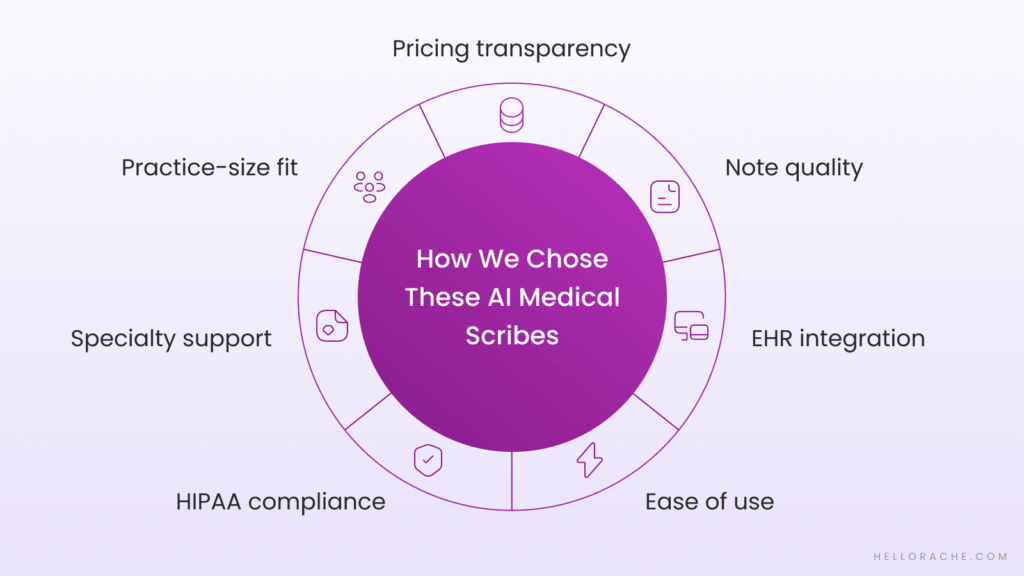
The following qualities played the greatest roles in our selection process:
- Pricing transparency: Public pricing was preferred. However, several enterprise tools require booking a call to receive a quote. In those cases, we assessed value based on features, positioning, and reported use cases.
- Note quality: Does the output require minimal editing and still sound like the physician? Strong tools produce clean, accurate clinical notes without extra work after each visit.
- EHR integration: Can the system push notes directly into the electronic health record, or does it rely on copy-and-paste? We looked at both depth and compatibility.
- Ease of use: How quickly can a provider get started? We considered setup time, learning curve, and how well the tool works across mobile devices.
- HIPAA compliance: We evaluated data encryption, privacy safeguards, and the protection of patient data within the clinical environment.
- Specialty support: Can the platform handle complex or multi-specialty clinical documentation without breaking accuracy?
- Practice-size fit: Each tool was assessed for solo providers, group practices, or enterprise-level systems.
Quick Comparison Table: 9 Best AI Medical Scribe Services
Not every AI medical scribe fits every practice. Some tools work best for solo providers. Others are built for large systems with complex EHR software needs. This quick comparison helps you scan the key differences before diving deeper.
| Tool Name | Best For | EHR Integration | Starting Price | HIPAA Compliant |
| Hello Rache | Human precision | All EHR systems (live) | $9.50 per hour | Yes |
| Freed AI | Solo practices | Browser-based push | Starts at $39 per month | Yes |
| Nuance DAX Copilot | Enterprise systems | Epic/Cerner (deep) | Not publicly available | Yes |
| Suki AI | Voice workflows | 30+ EHRs | Not publicly available | Yes |
| Abridge | Epic users | Epic native | Not publicly available | Yes |
| DeepScribe | Specialty care | 30+ EHRs | Not publicly available | Yes |
| Augmedix | Hybrid AI + human | Enterprise EHRs | Custom pricing | Yes |
| DeepCura | All-in-one platform | 7+ bi-directional EHRs | $129 per month | Yes |
| OrbDoc | Offline use | Universal (offline capable) | Not publicly available | Yes |
The 9 Best AI Medical Scribe Services of 2026
Choosing the right AI medical scribe depends on how well it fits your workflow. Some tools focus on speed, others on accuracy. What matters is how they handle EHR software and maintain HIPAA compliance while supporting real-world clinical documentation.
1. Hello Rache: For practices that want human precision
| Hello Rache | |
| Live human Healthcare Virtual Assistants® for practices where documentation accuracy and clinical judgment can’t be left to AI alone | |
| Best for: | Independent practices, specialty clinics, and growing group practices that need real-time EHR documentation with the reliability and adaptability of a trained healthcare professional |
| Key features: | • Live, real-time documentation directly into any EHR system. It works with Epic, Athena, eClinicalWorks, and all major platforms • Healthcare Virtual Assistants® are registered nurses and allied health professionals. They understand clinical context, not just transcription patterns. • HIPAA-trained/certified. Virtual assistants receive extensive training on your specific EHR workflow and clinical preferences before day one. • Dedicated account manager ensures consistent quality. There are no surprise substitutions. • No setup fees, no long-term contracts; scale up or down as your practice needs change |
| Drawback: | Human scribes are not available 24/7 for autonomous after-hours note generation the way AI tools are. Best suited for practices with consistent scheduled hours |
| Pricing: | $9.50/hour. No setup fees. No contracts. Schedule a free consultation to discuss your practice’s needs. |
| → Hello Rache is the only option on this list that pairs clinical expertise with documentation support. For practices where accuracy is non-negotiable, that difference matters. | |
2. Freed AI: For solo providers and small practices that want fast, affordable note generation
| Freed AI | |
| Best budget-friendly ambient AI scribe for independent practices | |
| Best for: | Solo practitioners and small practices that want fast, accurate SOAP notes without complex EHR setup |
| Key features: | • Ambient listening with real-time note generation. It learns the clinician’s preferred style over time. • One-click EHR push into any browser-based EHR via Chrome extension • Pre-visit summaries, post-visit patient instructions, and ICD-10 code generation • Free trial available and minimal onboarding. Most users are live the same day. • HIPAA-compliant with BAA available |
| Drawback: | Relies on browser-based EHR push via Chrome extension / EHR Integrations Agent in beta. Style can vary slightly between encounters, but the team is actively improving consistency. |
| Pricing: | Starts at $39/month per provider. Free trial available. |
3. Nuance DAX Copilot: For enterprise health systems already standardized on Epic or Cerner
| Nuance DAX Copilot | |
| Enterprise-grade ambient AI with the deepest Epic integration on the market | |
| Best for: | Large hospital systems and health networks already standardized on Epic or Cerner |
| Key features: | • Ambient capture embedded directly in Epic and Cerner. Note delivered in 2–3 minutes post-visit • HITRUST certification and Microsoft Azure-level security infrastructure • Programmatic rollout support for complex multi-department deployments • Backed by Microsoft’s enterprise security and compliance framework |
| Drawback: | Not designed for small or independent practices. It requires enterprise IT sign-off and significant onboarding. |
| Pricing: | Not available. Contact Nuance for a quote. |
4. Suki AI: For clinicians who want to combine voice-driven documentation and workflow commands
| Suki AI | |
| Voice-first AI assistant for clinicians who want documentation and workflow commands in one tool | |
| Best for: | Outpatient physicians and mobile clinicians who prefer a voice-driven workflow over ambient listening |
| Key features: | • Dictation plus ambient listening. Physicians can speak naturally or give voice commands • Integrates with different EHR systems like Epic, Athenahealth, Oracle, and Meditech. It pulls patient schedule context before each visit • Voice commands for orders, referral letters, HCC/ICD-10 suggestions • Multilingual dictation support (12+ languages). It’s well-suited for multilingual clinics • Strong KLAS implementation marks |
| Drawback: | Specialty depth varies by site and EHR build. Complex specialty practices should validate performance locally before committing. Best results for primary care. |
| Pricing: | Not available. Contact Suki AI for enterprise pricing. |
5. Abridge: For practices using Epic looking for patient-friendly visit summaries
| Abridge | |
| Epic-native ambient scribe with patient-friendly visit summaries built in | |
| Best for: | Practices embedded in Epic that also want to deliver lay-language visit summaries to patients |
| Key features: | • One-tap launch from Epic Haiku/Canto mobile apps. Notes are generated in under 2 minutes. • Auto-creates patient-facing visit recap PDFs. This is a differentiator for patient engagement. • Supports 50+ specialties and 28+ language vocabulary for documentation accuracy • Full HIPAA compliance • 90-day audio retention (note: audio not linked to specific transcript timestamps) |
| Drawback: | Enterprise sales only. There are no single-provider licenses available. It requires an Epic Ambient Listening license. Not suitable for practices outside the Epic ecosystem. |
| Pricing: | Not available. Contact Abridge for current enterprise rates. |
6. DeepScribe: For specialty practices that need deep clinical terminology support and strong note quality
| DeepScribe | |
| Highest KLAS-rated AI medical scribe for complex specialty practices | |
| Best for: | Multi-specialty clinics and specialty practices (oncology, cardiology, orthopedics, neurology) requiring deep terminology understanding |
| Key features: | • 98.8 KLAS spotlight score, which is the highest in the ambient AI scribe category • Specialty-tuned AI models for complex documentation. It learns each clinician’s unique documentation style. • Contextual notes pull prior history, labs, and diagnostics for longitudinal coherence • Built-in HCC, CPT, and ICD-10 coding suggestions to support billing accuracy • Hybrid AI + human quality assurance option available for highest-stakes documentation |
| Drawback: | Pricing is not publicly disclosed. It requires a sales conversation and longer onboarding than lightweight tools. Better suited for practices with dedicated IT support. |
| Pricing: | Not available. Contact DeepScribe for current pricing. |
7. Augmedix: For large practices that want AI-assisted documentation with human quality review
| Augmedix | |
| Hybrid AI + live human QA scribe for practices that can’t afford documentation errors | |
| Best for: | Large practices and specialty groups with strict accuracy requirements — particularly where human oversight is non-negotiable |
| Key features: | • Hybrid model: AI captures and transcribes and human medical documentation specialists review for accuracy. • Wearable camera or phone stand option for hands-free documentation • Works across 35+ specialties. Offers strong performance in complex, high-acuity encounters. • Enterprise-grade EHR integrations with real human escalation for edge cases • HIPAA-compliant with full BAA |
| Drawback: | Slower turnaround than pure AI tools due to human QA layer. An enterprise contract is required, as pricing and onboarding are not self-serve. Not suitable for solo practitioners or budget-constrained practices. |
| Pricing: | Custom enterprise pricing only. Contact Augmedix for a quote. |
8. DeepCura: For growing practices that want one platform for scribing, intake, and automation
| DeepCura | |
| Best multi-platform automation suite for growing practices that want to replace multiple point solutions | |
| Best for: | Multi-provider group practices looking for a single platform covering scribing, reception automation, billing, and intake |
| Key features: | • Bi-directional EHR integration with Epic, eClinicalWorks, Athena, AdvancedMD, and more • GPT-4 and Bio Clinical BERT AI models for high transcription accuracy across specialties • Supports 50+ specialties through configurable templates. There is a 34-language support • Covers scribing, AI reception, billing automation, and patient intake in one subscription • Rated 4.8/5 on Capterra from verified healthcare providers; free trial available |
| Drawback: | Steeper learning curve than single-purpose AI scribes due to platform breadth; smaller user community than established players like Freed or Nuance DAX |
| Pricing: | Starts at $129/month per provider (all features included). Free trial available. No credit card required. |
9. OrbDoc: For offline-first practices that need audit-friendly documentation support
| OrbDoc | |
| Only AI scribe with offline capability and timestamp-linked evidence for audit defense | |
| Best for: | Rural practices, home visit clinicians, and practices with strict audit-defense or malpractice documentation requirements |
| Key features: | • Processes audio locally on device. It’s the only AI scribe that works without internet connectivity. • Evidence-linking. Every statement in the note links back to the exact timestamp of the conversation. • 7-year audio retention for malpractice and payer audit defense. No other major platform offers this • Month-to-month contracts. There are no setup fees and custom specialty templates are available. • HIPAA-compliant |
| Drawback: | Smaller product community and less brand recognition than Freed or Nuance DAX; requires local device storage management for audio retention; no team collaboration features for large groups |
| Pricing: | Not available. Contact OrbDoc for a custom quote. |
AI Medical Scribe vs. Human Scribe: What’s the Difference?
Many medical scribe companies now offer both AI and human options. These may seem similar. But they actually solve different problems. The right choice depends on how much accuracy, speed, and flexibility your clinical workflow requires.
AI Medical Scribes
An AI medical scribe works best for routine visits. It generates clinical notes quickly, supports ambient clinical documentation, and stays available at all times. For high-volume patient encounters, that speed matters.
But it has limits. AI can:
- Produce errors in complex cases
- Misread clinical context
- Miss nuance
It still needs physician review before sign-off, especially when accuracy affects care decisions.
Human Medical Scribes
Human scribes bring judgment and adaptability. This is where you clearly see how a medical scribe can help physicians. They catch inconsistencies, adjust in real time, and support EHR workflows without disrupting care.
Research backs this up. A 2025 study in npj Digital Medicine found that human medical scribes are more than four times as likely to produce documentation that physicians consider accurate. That level of reliability is hard to replace in complex care.
Hybrid Reality
Most practices don’t choose one approach. They use AI for straightforward visits and human support for complex or high-stakes documentation.
Cost Considerations
AI tools typically range from $39 per month. In comparison, Hello Rache’s human Healthcare Virtual Assistants® offer virtual medical scribe services starting at $9.50 per hour. For full clinic days, that can align closely with mid-range AI pricing while delivering higher accuracy.
Choosing The Right AI Medical Scribe for Accuracy, Efficiency, and Growth
Choosing an AI medical scribe focuses on what actually helps during a busy clinic day. Less typing. Fewer interruptions. And more attention to patient care.
Across this guide, you’ve seen how different tools approach clinical documentation. Some focus on fast clinical notes and simple workflows. Others go deeper, with stronger EHR integration, specialty support, and better handling of complex patient encounters.
This is where you have to decide whether your practice needs a digital scribe or a human scribe.
AI tools are efficient. They handle routine visits well and quickly reduce the documentation burden. But they still need oversight. They can miss nuance, especially in more complex cases.
Human support works differently. It adapts in real time, understands clinical context, and helps ensure accuracy from the start.
That’s why many practices don’t choose one or the other. They use both, depending on the situation.
If your practice needs documentation support that goes beyond automated note generation, Hello Rache’s Healthcare Virtual Assistants® are ready to work in your EHR software from day one.
SCHEDULE A FREE CONSULTATION to see how it works.
Frequently Asked Questions About AI Medical Scribe Services
What Is the Best AI Scribe for Doctors?
The best AI medical scribe depends on your workflow. Solo providers may prefer simple tools with fast clinical notes. Larger practices often need deeper EHR integration and specialty support.
How Much Does an AI Medical Scribe Cost?
Pricing varies widely. Most AI scribes start from $39 per month. Healthcare virtual assistants offering virtual medical scribe services may start around $9.50 per hour.
Are AI Medical Scribes HIPAA Compliant?
Most leading platforms comply with HIPAA standards, including encryption and secure data handling. Always verify how patient data is stored and processed.
Can AI Medical Scribes Integrate With Epic?
Yes, many tools support Epic. Some offer direct integration, while others rely on browser-based workflows or manual upload into the electronic health record.