

Busy healthcare providers face a myriad of challenges every day.
They’re met with the dual pressure of delivering exceptional patient care while managing the labyrinth of revenue cycle management (RCM).
Slow cash flow, rising claim denials, and the crushing weight of administrative overhead are symptoms of a broken system. Many medical practices fix this system by outsourcing medical billing. It’s not merely an operational choice. It’s a strategic necessity.
However, finding the best medical billing companies and choosing the right partner isn’t always straightforward. This article is your guide to choosing the best medical billing company for your practice. We review the seven top contenders and highlight what sets each apart from the others, helping you make an informed decision.
Highlights
- Claim-denial rates increased for 60% of medical groups in 2024, with the average appeal costing up to $95 in labor alone. Outsourcing can help lower denial rates while reclaiming the 13+ hours per week the average physician spends on prior authorization and other billing tasks.
- Your medical practice’s financial health requires a high first-pass claim acceptance rate. Top medical billing companies should target 95% or higher to minimize costly rework and expedite the reimbursement process.
- Your partner’s pricing model is a decisive factor. You must evaluate whether a percentage-of-collections model or a transparent, budget-friendly hourly rate is the right fit for your healthcare practice.
- HIPAA compliance is non-negotiable. Any billing company you choose must demonstrate strict adherence to HIPAA standards and security best practices for handling sensitive patient data.
What Is Medical Billing and How Does It Work?
Medical billing is the process of translating healthcare services into a standardized request for payment. It’s the complex bridge between a clinical encounter and financial solvency.
This workflow involves much more than just hitting “send” on an invoice. It’s a component of revenue cycle management (RCM) that begins well before the patient even sees the doctor. A healthy medical billing workflow encompasses:
- Patient scheduling and registration
- Insurance verification
- Prior authorization (if needed)
- Clinical documentation
- Medical coding in ICD-10 codes and the upcoming ICD-11
- Claims processing
- Reimbursement process
- And denial management
Outsourcing Medical Billing: A Strategic Advantage
Consider the workload involved in just one aspect of the billing cycle: prior authorization.
According to research from the AMA, physicians and their staff spend an average of 13 hours per week completing 39 prior authorizations per physician. This doesn’t just drain almost a third of your work week, but it’s also a primary driver of burnout in nine out of 10 cases.
Many busy medical practitioners choose to outsource this complicated process to a specialist billing company or a medical billing virtual assistant.
This strategic decision transfers the administrative burden to experts. It allows your high-cost in-house staff to focus on patients rather than paperwork, instantly lowering administrative costs and improving your accounts receivable (A/R).
Criteria for Choosing a Medical Billing Company
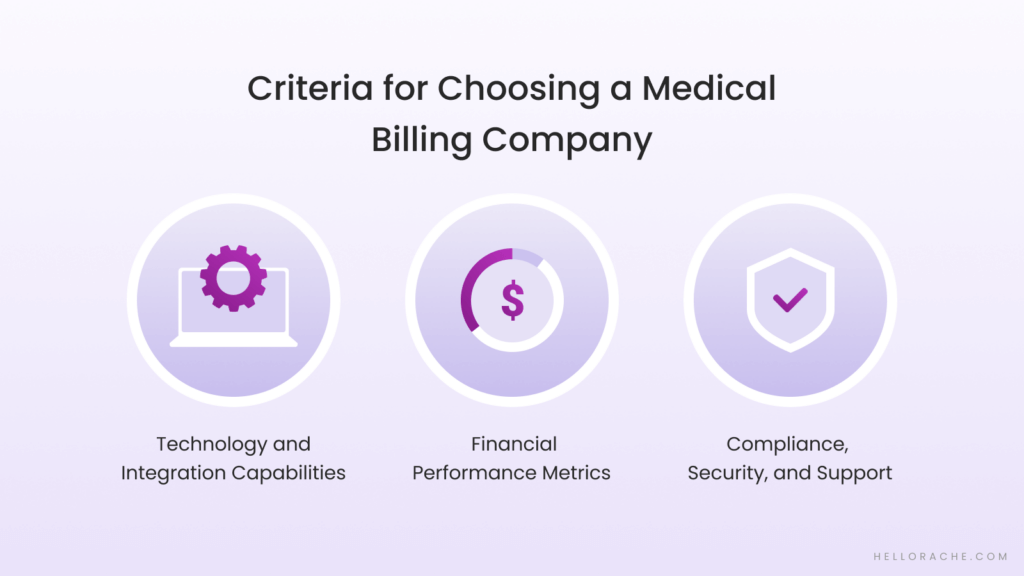
Selecting a partner for your practice management is a high-stakes decision. You need to look beyond the sales pitch and evaluate their ability to fight for your revenue using a structured set of criteria.
Technology and Integration Capabilities
A modern billing company is defined by its technology (tech) stack.
You need a partner whose billing software can talk to your existing systems. Look for a solution that offers an all-in-one platform or integrates seamlessly with your electronic health records (EHR) system.
The technology must support advanced functions like:
- Robust reporting capabilities through KPI dashboards and financial reports
- Support for integrated delivery networks if you are part of a larger group
- Secure patient portal access if you are a smaller clinic
- Pre-submission claim scrubbing
- Electronic insurance verification
Access to this kind of automation and detailed data analytics is crucial for making informed business decisions.
Financial Performance Metrics (The Money Talk)
Medical billing isn’t a passive administrative task; it’s an active battle for revenue and profitability. When vetting a partner, demand to see their metrics. The statistics show why this is necessary:
According to a comprehensive survey by KFF, insurers denied 20% of all claims in 2023. That is one in every five claims rejected. If your billing partner is performing at “average” levels, you’re losing massive amounts of revenue. You need a partner aiming for the following KPIs:
| Performance Metric | Goal | RCM Impact |
|---|---|---|
| First-Pass Claim Acceptance Rate | > 95% | Faster reimbursement, lower administrative costs |
| Days in Accounts Receivable (A/R) | < 30 days | Improves cash flow predictability and solvency |
| Denial Rate | < 5% | Reduces rework and maximizes collected revenue |
Additionally, ask about their strategy for denial management. Appealing a denied claim costs healthcare institutions and physicians $57.13–$95.04, yet fewer than half of appeals are successful (source: Premier). Therefore, the strategy can’t just be “we will appeal everything.” The medical billing strategy must be prevention.
Compliance, Security, and Support
In the healthcare industry, compliance and security are non-negotiable. A single data breach can set you back $7.42 million, a significant portion of which comes from penalties for non-compliance (source: IBM).
Your chosen billing company must provide guarantees of HIPAA compliance and security for all medical records and patient data. This includes:
- Regular billing audit processes
- Secure data transmission
- Robust access controls
- HIPAA-certified staff
Beyond compliance, evaluate the quality of customer support. You need dedicated communication channels and timely responses from their team. Changing or moving your RCM process is a major change, and you need a partner who makes it seamless.
The 7 Best Medical Billing Companies
We curated a list of the seven best options on the market, ranging from software giants to agile, human-centric solutions.
Hello Rache
Hello Rache stands apart from the crowd by focusing on the most critical element of the billing process: the human expertise required to navigate it.
Hello Rache connects practices with HIPAA-compliant Healthcare Virtual Assistants® (VMAs). These are real, qualified medical professionals (often nurses) based in the Philippines who integrate directly into your practice’s medical billing workflow.
Key Medical Billing Services
- Medical coding support and data entry into your specific EHR
- Prior authorization processing and tracking
- Insurance verification and eligibility checks
- Preliminary claims submission and review
- Patient statements and billing inquiries
Pros and Cons
| Pros | Cons |
| Budget-friendly flat rate effectively lowers overhead | Requires a brief onboarding period to learn your specific office protocols |
| No contracts, setup fees, or percentage-of-collections skimming | Not a standalone software platform |
| Staff are HIPAA-certified medical professionals with clinical knowledge | |
| Highly flexible assistants |
Pricing Model
Hello Rache has a simple pricing model:
| Model | Rate | Details |
|---|---|---|
| Flat-rate hourly | $9.50 per hour | Simple, transparent billing |
Best Fit
Solo practitioners to mid-sized clinics and healthcare practices seeking dedicated, long-term team members who will adapt to their current software.
Athenahealth
Athenahealth is a massive player in the healthcare industry. It offers a cloud-based ecosystem that combines EHR, practice management, and patient engagement into a single network.
Key Medical Billing Services
- Real-time claim scrubbing based on network-wide data
- Comprehensive financial reports and benchmarking
- Denial management and automated appeals
- AI-native software
Pros and Cons
| Pros | Cons |
|---|---|
| Powerful revenue intelligence based on massive data sets | Percentage-of-collections model can be expensive |
| Seamless integration between clinical and financial workflows | Steep learning curve for staff |
| “Gamified” dashboard makes tracking KPIs intuitive |
Pricing Model
| Model | Rate | Details |
|---|---|---|
| Percentage of collections | Typically 4–7% | Rates vary based on specialty and claim volume |
Best Fit
Athenahealth is best suited for new practices and growing medical groups that want a single, integrated system and value deep data insights for market benchmarking.
CareCloud
Similar to Athenahealth, CareCloud offers powerful proprietary technology for medical billing with a sleek, user-friendly interface. It’s recognized for its flexible architecture, which allows medical groups to handle complex billing scenarios across various medical specialties.
Key Medical Billing Services
- Patient experience management and payment portals
- Advanced rules engine for claim scrubbing
- Centralized claims management system
- Data analytics for operational visibility
Pros and Cons
| Pros | Cons |
|---|---|
| Modern, intuitive interface that improves staff efficiency | Custom reporting can be complex to configure without assistance |
| They claim first time pass rates as high as 97% | Customer support response times can vary |
| Scalable for multi-specialty groups | Steep learning curve that requires onboarding and staff training |
Pricing Model
| Model | Rate | Details |
|---|---|---|
| Hybrid / Custom | Custom quote | Mix of subscription software fees and percentage-based RCM fees |
Best Fit
CareCloud is ideal for practices that prioritize data-driven RCM and aim to proactively minimize denials through advanced technology and a modern user interface.
Tebra (Formerly Kareo)
Tebra is the result of the merger between Kareo (a clinical/billing software provider) and PatientPop (a practice growth company), creating a comprehensive platform for independent practices. It bridges the gap between acquiring patients via marketing and getting paid for treating them via medical billing.
Key Medical Billing Services
- Patient engagement tools (reminders, digital intake)
- Automated eligibility checks and claim tracking
- Simplified patient collections and statements
- Integrated EHR and billing software
Pros and Cons
| Pros | Cons |
|---|---|
| Extremely user-friendly and designed for smaller teams | May lack the deep customization required by large, complex health systems |
| Excellent integration of marketing and billing functions | Requires onboarding and training |
| Transparent dashboard for tracking claim status | All-in-one bundles can be expensive |
Pricing Model
| Model | Rate | Details |
|---|---|---|
| Subscription + % | Starts ~$200 per month physician | Base software subscription plus add-on fees for full-service billing |
Best Fit
Tebra is the top choice for independent or small practices seeking a simplified, all-in-one solution that handles everything from marketing to billing without IT complexity.
AdvancedMD
AdvancedMD is a powerhouse for those who need scalability and depth. Their practice management solutions are highly modular, allowing practices to choose between using their software for in-house billing or outsourcing the entire revenue cycle to AdvancedMD’s services team.
Key Medical Billing Services
- Centralized billing office (CBO) tools for large groups
- Credit card processing and patient payment plans
- Claim scrubbing and automated submission
- Denial prevention & recovery services
Pros and Cons
| Pros | Cons |
|---|---|
| Highly scalable for rapidly growing or multi-location practices | The sheer number of features and modules can be overwhelming |
| Flexible choice between software-only or full-service RCM | Implementation can be time-consuming due to the system’s depth |
| Robust reporting for financial reports |
Pricing Model
| Model | Rate | Details |
|---|---|---|
| Custom bundles | 4—8% of billing + software fees | Pricing depends heavily on claim volume and the specific modules selected |
Best Fit
AdvancedMD is best for large or rapidly growing practices that need deep customization, complex reporting, and the ability to scale their RCM operations quickly.
DrChrono
DrChrono built its reputation by being the first EHR for iOS, with a strong focus on mobile usability for providers. Their platform integrates EHR, practice management, and RCM with a focus on ease of use and mobile-first workflows.
Key Medical Billing Services
- AI medical scribe integration for documentation
- Mobile-first charge capture and billing
- Real-time medical coding assistance
- Electronic prior authorization tools
Pros and Cons
| Pros | Cons |
|---|---|
| Incredible mobile functionality allows providers to work from an iPad | The desktop version can feel less robust than the mobile app |
| Intuitive workflow reduces administrative friction | |
| Innovative features like AI integration |
Pricing Model
| Model | Rate | Details |
|---|---|---|
| Subscription + % | Starts at ~$200 per month + 4–8% | Base EHR license fees plus percentage of collections |
Best Fit
DrChrono is the go-to solution for providers who prioritize mobile functionality and want to manage clinical documentation and billing directly from an iPad.
Transcure
Transcure is a dedicated RCM service provider that prides itself on financial rigor and high accuracy metrics. Unlike some software-first companies, Transcure’s primary value proposition is its aggressive pursuit of every dollar owed through specialized back-office support.
Key Medical Billing Services
- End-to-end revenue cycle management
- Coding audits and compliance reviews
- Credentialing and contract negotiation
- Claim appeals and dispute resolution
Pros and Cons
| Pros | Cons |
|---|---|
| High First Pass Clean Claims Rate (often cited at 98%) | Less focus on the user experience of the software interface |
| Strong expertise in complex payer contract negotiations | |
| Dedicated account managers for personalized support |
Pricing Model
| Model | Rate | Details |
|---|---|---|
| Percentage of collections | ~5% | Performance-based model |
Best Fit
Transcure is best for practices with a primary, non-negotiable focus on maximizing financial returns through high claim accuracy and aggressive A/R recovery.
Final Thoughts on the Best Medical Billing Companies
The medical billing landscape is a battleground. With claim-denial rates increasing for 60% of medical groups (MGMA), you can’t afford to have a passive approach to revenue cycle management.
Choosing the right medical billing company is about matching your specific needs to the right solution. While software platforms like Athenahealth or AdvancedMD offer powerful tools, they often come with high percentage-based fees.
Hello Rache offers a compelling alternative: expert, human support at a low flat rate. You don’t just get software; you get a dedicated professional who tackles the workload that burns out your staff.
FAQs on the Best Medical Billing Companies
What Is the Average Claim Acceptance Rate I Should Expect From a Top Medical Billing Service?
You should expect a minimum of 95% or higher on the first pass. Since the industry average denial rate is now hovering around 20%, a partner who can achieve 95% acceptance is superior to the market average.
How Does Medical Billing Impact the Quality of Patient Care?
Inefficient billing drains resources. When staff spend over 13 hours a week on billing tasks, they aren’t interacting with patients. By outsourcing billing and administrative tasks, you reduce provider burnout and ensure that your team’s energy is directed toward patient engagement and clinical outcomes.
Should I Choose a Flat-Fee or a Percentage-Of-Collections Pricing Model?
This depends on your goals. A percentage-of-collections model aligns incentives but can become very expensive as your revenue grows. A flat-fee model, like Hello Rache’s $9.50 per hour, offers stability and predictability.