

Something’s got to give before your practice’s staff starts a protest against paperwork. Managing a clinic in today’s healthcare landscape is tough. You’re likely dealing with a heavy administrative responsibilities load. This burden pulls your medical office staff away from patient care.
While hiring help is a great move, you need a plan first. Learning the right things to do before hiring a virtual medical assistant keeps you from wasting time and money.
For example, Hello Rache specializes in matching practices with a virtual medical assistant who fits. But even then, you still need proper preparation to get the best results from day one.
In this article, we cover the nine steps to get your workflow ready for a new team member.
Highlights
- Follow these things to do before hiring a virtual medical assistant to ensure strict HIPAA compliance
- Create detailed clinic protocols and standard operating procedures to ensure high patient satisfaction
- Assess your current workflow to identify which office tasks cause the most significant bottlenecks
Why Preparation Matters Before Hiring a Virtual Medical Assistant
Success in the healthcare sector depends on the strength of your foundational systems.
That’s why hiring without a plan leads to high turnover and wasted resources in your healthcare environment. Without a clear workflow, a new hire spends more time asking questions than completing work, forcing your office manager to micromanage.
Proper planning increases the success rate by letting you identify the exact EHR systems and clinical workflows to delegate.
According to an American Medical Association article, physicians lost more than seven hours per week to administrative tasks in 2024. Having clarity about when to delegate and when to hire not only speeds up onboarding but also reduces wasted time on administrative tasks. Plus, it helps the assistant feel confident in their role from day one and increases their success.
Preparation is the difference between a good hire and a great one who improves your billing efficiency. By setting up your software and clinic protocols now, you build a scalable model for long-term growth. This protects your patient experience during labor-force reductions and prevents the need to rebuild your systems every time you add an FTE (Full-Time Equivalent).
9 Things To Do Before Hiring a Virtual Medical Assistant
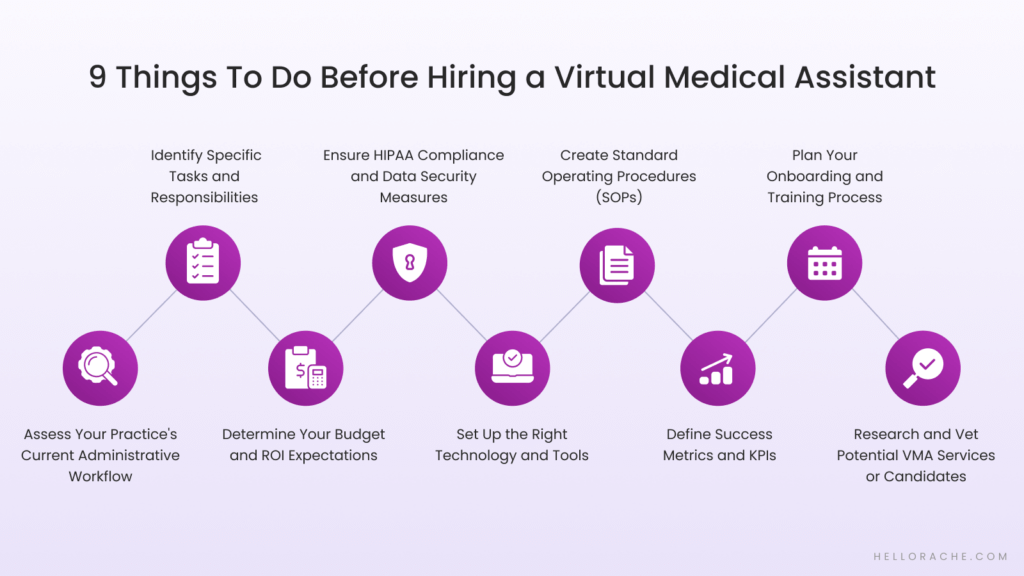
Building a successful partnership with a remote assistant requires a structured approach. Follow these nine steps to ensure you are ready for remote support.
1. Assess Your Practice’s Current Administrative Workflow
You must understand your current internal processes before you can successfully delegate them. Start by watching how tasks move through your office.
Action items:
- Conduct a time audit of administrative tasks
- Identify bottlenecks and pain points
- Document which tasks consume the most staff time
- List repetitive tasks that could be delegated
Why this matters: You cannot delegate effectively if you don’t know the exact steps required to complete a task. Knowing your workflow helps you see where an assistant provides the most relief.
Common mistakes to avoid: Many practices make the mistake of delegating randomly without a strategy. This results in the assistant handling low-priority tasks while you remain buried in complex patient records.
2. Identify Specific Tasks and Responsibilities
Understanding what a virtual medical assistant does in a daily setting helps you narrow down your own needs. You can’t expect someone to help you if they don’t know where to start. Once you define the role, you can look for an assistant with the right training for your specialty.
Categories of VMA tasks:
- Administrative duties (appointment scheduling, patient communication)
- Insurance verification and pre-authorization
- Medical transcription and documentation
- Medical billing and coding support
- Email and phone management
- Patient intake and follow-up
According to an article in the American Journal of Managed Care, physicians complete an average of 39 prior authorizations per week. This burden takes up ~13 hours of their time every single week. The right VMA can give you back that time.
Action items:
- Create a comprehensive task list
- Prioritize tasks by importance and urgency
- Determine which tasks require specific certifications
- Identify tasks that require HIPAA-compliant handling
Hello Rache can help customize these job descriptions based on your specific specialty. This ensures you get exactly the kind of support your practice requires from the start.
3. Determine Your Budget and ROI Expectations
Hiring a medical billing virtual assistant can help you manage your costs more effectively. But first, establish a clear financial plan so that your new hire contributes to the practice’s profitability. Think about the long-term value of your time.
Budget considerations:
- Comparing the cost of a remote assistant to a local, in-person medical assistant
- Factoring in the cost of HIPAA-compliant tools and additional software licenses
- Deciding between a part-time or FTE role based on your patient demands
- Evaluating the cost of training and the time required for initial onboarding
- Average hourly or monthly VMA rates
ROI calculation:
- Measuring the reduction in insurance claims denials through better medical coding
- Estimating the number of additional patient appointments you can see per week
- Calculating the time saved for physicians to focus on direct patient care
- Improving billing efficiency and shortening the overall revenue cycle
Action items:
- Set a realistic budget range
- Calculate the current costs of administrative tasks
- Project potential time savings
- Determine the breakeven point
According to MGMA research, 92% of medical group leaders reported increased operating expenses in 2024. Hello Rache offers transparent pricing at $9.50 per hour with no hidden fees, reducing operating expenses. They can provide ROI projections based on practice size and specialty.
4. Ensure HIPAA Compliance and Data Security Measures
Protecting patient data is your most critical responsibility when integrating remote staff. You must have a secure environment ready for them to join.
As you’re doing this, keep in mind that you might need help with different types of medical virtual assistants depending on your specialty and billing needs. Any data that these MVAs access must be fully secure.
Critical compliance areas:
- Verifying that all telehealth platforms and communication tools are HIPAA-compliant
- Implementing strict password policies and multi-factor authentication for EHR use
- Establishing protocols for the secure transfer of electronic medical records
- Executing a valid Business Associate Agreement with your VMA provider
- Ensuring the assistant works in a private, secure healthcare environment
Action items:
- Review your current HIPAA compliance status
- Prepare BAA templates
- Identify HIPAA-compliant software tools
- Create security protocol documentation
- Plan for HIPAA training requirements
Red flags to watch for:
- Lack of encryption on the telemedicine platforms used by the service
- Providers that do not offer specific HIPAA training to their assistants
- Offshore services with vague data protections
- VMA services that hesitate to sign a BAA
Best practices:
- Regular security audits to check for vulnerabilities in your healthcare systems
- Limited access principles so assistants only see the data they need to work
- Secure file sharing solutions to protect sensitive patient data from leaks
Maintaining a high standard is the key to success for HIPAA compliance in any modern practice. All Hello Rache virtual assistants undergo rigorous training to ensure they understand HIPAA regulations. We also provide a comprehensive BAA as a standard part of our service.
5. Set Up the Right Technology and Tools
Your virtual medical assistant needs a reliable and secure tech stack to perform their duties. Check that your internet and software can handle remote logins.
Essential technology you need includes:
- Electronic Health Records (EHR) access and permissions
- Communication platforms (HIPAA-compliant)
- Practice management software compatibility
- Secure file-sharing systems
- Project management tools
- Time tracking software
Action items:
- Audit current software capabilities
- Research VMA-compatible tools
- Set up user accounts and permissions
- Test remote access protocols
- Create technology onboarding documentation
Integration considerations:
- Choosing between cloud-based systems and on-premise servers for remote work
- Ensuring mobile accessibility for telehealth support and patient communication
- Checking for multi-user licensing limits on your current medical software
Hello Rache provides technical onboarding support and can recommend HIPAA-compliant tools compatible with most practice management systems. This ensures your onboarding process goes off without a hitch.
6. Create Standard Operating Procedures (SOPs)
Documentation is the bridge that allows your remote assistant to replicate the quality of your in-office care. Without them, you will spend your entire day answering simple questions.
Why SOPs matter:
- Consistency in patient care by providing a clear manual for every task
- Quality control for all administrative responsibilities in the clinic
- Easier training and onboarding for new remote or in-office staff
- Scalability for future hires as your practice grows and expands
What to document:
- Brand voice and communication standards
- Phone and email response templates
- Emergency escalation procedures
- Patient communication guidelines
- Billing and coding procedures
- Patient scheduling protocols
Action items:
- Identify all procedures that need documentation
- Create step-by-step written guides
- Include screenshots or video tutorials where helpful
- Organize SOPs in an accessible knowledge base
- Plan for regular SOP updates
Format suggestions:
- Video walkthroughs for complex processes
- Written procedures with checklists
- Quick reference guides
- FAQ documents
Following these steps allows your virtual administrative assistant to work independently. A well-written SOP acts as a manual for your practice during the daily rush. It keeps everyone on the same page and reduces errors.
7. Define Success Metrics and KPIs
You need an objective way to measure how the assistant is impacting your practice. If you can’t measure it, you can’t improve it.
Key performance indicators:
- Appointment no-show rates
- Time saved for clinical staff
- Patient satisfaction scores
- Response time metrics
- Task completion rates
- Billing accuracy
Action Items:
- Set specific, measurable goals
- Establish baseline metrics before hiring
- Create a performance tracking system
- Schedule regular review periods
- Determine evaluation criteria
Monitoring tools:
- Dashboard software like that provided by Hello Rache to track time, daily task completion, and billing efficiency
- Patient feedback mechanisms to measure the impact on the patient experience
Using the right tasks for virtual assistants ensures your team focuses on high-value patient interactions. There is virtually no risk when you hire through Hello Rache. No contract, cancel anytime, and weekly billing means there’s no long-term commitment.
8. Plan Your Onboarding and Training Process
A structured onboarding period is essential for integrating a new assistant into your healthcare profession. You should have a calendar ready for their first month.
Onboarding timeline:
- Week 1: Focus on system access, security protocols, and practice orientation
- Week 2: Begin training on basic office tasks and patient calls
- Week 3-4: Supervised task completion with regular feedback and clinical support
- Ongoing: Regular check-ins and feedback to ensure long-term success and growth
Training components:
- Orientation on your specific EHR/EMR systems and clinical preferences
- Deep dive into your HIPAA compliance and data security requirements
- Education on your practice’s unique clinic protocols and brand voice
- Review of medical billing and coding standards used in your office
- Walkthrough of your scheduling software and patient portal
Action items:
- Create an onboarding schedule
- Prepare training materials and resources
- Assign a point person for questions
- Set up regular check-in meetings
- Develop a 30-60-90 day plan
Best practices:
- Start with simple tasks and increase complexity as the assistant learns
- Provide written and verbal instructions for all patient appointments
- Give constructive feedback early and often to maintain high quality
- Allow time for questions to prevent confusion during the daily rush
Hello Rache’s virtual assistants come pre-trained in medical terminology and HIPAA standards. This significantly reduces your onboarding burden. Hello Rache also provides ongoing support during the transition period to ensure everything goes well.
9. Research and Vet Potential VMA Services or Candidates
Choosing the right partner is the final step before hiring a virtual medical assistant.
Research considerations:
- Industry experience and specialization
- Certification and training programs
- Company reputation and reviews
- HIPAA compliance track record
- Communication and availability
- Pricing structure and contracts
Questions to ask:
- What is your vetting and training process?
- What are your communication protocols?
- What medical specialties do you serve?
- How do you ensure HIPAA compliance?
- What happens if a VMA isn’t a good fit?
- Do you provide backup coverage?
Red flags to avoid:
- Poor communication or responsiveness
- No clear HIPAA compliance measures
- Lack of medical industry experience
- No trial period or guarantees
- Unwillingness to sign BAAs
Action items:
- Create a shortlist of potential providers
- Schedule discovery calls
- Request references from other medical practices
- Compare pricing and services
Finding the best virtual assistants requires looking for a partner that understands the high-stakes nature of medicine. Here’s what you get when partnering with Hello Rache:
- Experience across multiple medical specialties
- Specialized in Healthcare Virtual Assistant®
- Replacement guarantee if the fit isn’t right
- Pre-vetted, HIPAA-trained professionals
- Dedicated account management
- US-based customer support
Bonus Tips for Success
Keep these in mind for a successful hire:
- Create a tech stack checklist for seamless onboarding
- Build a relationship, not just a work arrangement
- Start with the most frequently performed tasks
- Consider time zone differences for coverage
- Document what works and what doesn’t
- Maintain open communication channels
- Schedule regular performance reviews
- Be patient during the learning curve
- Start small and scale up
Hello Rache recommends starting with a trial period or part-time arrangement to ensure the right fit before committing to full-time support.
Are You Ready To Take the Next Step?
Preparing your practice for a virtual assistant is a rewarding investment. By taking the time to assess your workflow, you set the stage for a seamless integration.
Securing your HIPAA protocols and documenting your clinic protocols protects your patients and your team. These things to do before hiring a virtual medical assistant are the foundation of a great partnership.
A well-prepared practice can transition from administrative overwhelm to clinical excellence in just a few weeks. This ultimately reduces your burnout and improves your overall patient satisfaction.
When you have the right systems and the right support in place, you can finally get back to the heart of your profession. You can focus on helping people heal rather than filling out endless forms.
Ready to transform your practice? Hello Rache is here to support practices through every step of the preparation and hiring process.