

Medical billing drives your practice’s financial health. When done well, payments arrive quickly, errors stay low, and your team spends less time on claims. But even small mistakes can lead to delays, denials, and lost revenue.
That’s why strong medical billing tips and tricks are important. The revenue cycle has become more complex. Insurance companies have stricter requirements, and patients expect clearer patient billing and payment options.
The good news is that you can optimize your billing process to improve cash flow and reduce rework. This also helps you collect what your practice has already earned.
In this guide, you’ll learn practical medical billing tips to reduce errors and enhance your revenue cycle management from start to finish.
Highlights
- Ongoing training for billing staff and smarter denial management strategies strengthen long-term healthcare revenue cycle management
- Strong medical billing tips and tricks help reduce claim denials, improve cash flow, and keep the revenue cycle smooth
- Modern billing software and electronic health records improve efficiency and reduce manual work across the claims process
- Accurate insurance eligibility, clean claims submission, and fewer medical billing errors lead to faster reimbursements
- Clear patient communication and flexible payment plans increase collections and reduce confusion around medical bills
Understand the Basics of Medical Billing
Medical billing is how your practice gets paid for the care you provide. It sits at the center of the revenue cycle, so even small issues can slow everything down.
It starts with medical billing and coding. A medical coder turns medical procedures into standardized coding systems using specific diagnosis codes. For example, they might use E11.9 for type 2 diabetes without complications. Or, they might enter J06.9 to refer to an upper respiratory infection.
These codes explain what the physicians performed and why it was medically necessary.
Then comes the claims process. Your team sends a medical claim to the insurance company through a claims submission. If the claim is clean, you get reimbursed. If not, it may be delayed, denied, or rejected.
This is where accuracy comes in. Errors in patient demographics, insurance details, or documentation often lead to medical billing errors and lost revenue.
Good record-keeping helps avoid that. Electronic health records (EHRs) keep data organized, complete, and easy to verify. This supports a smoother revenue cycle management.
10 Medical Billing Tips and Tricks You Should Know in 2026
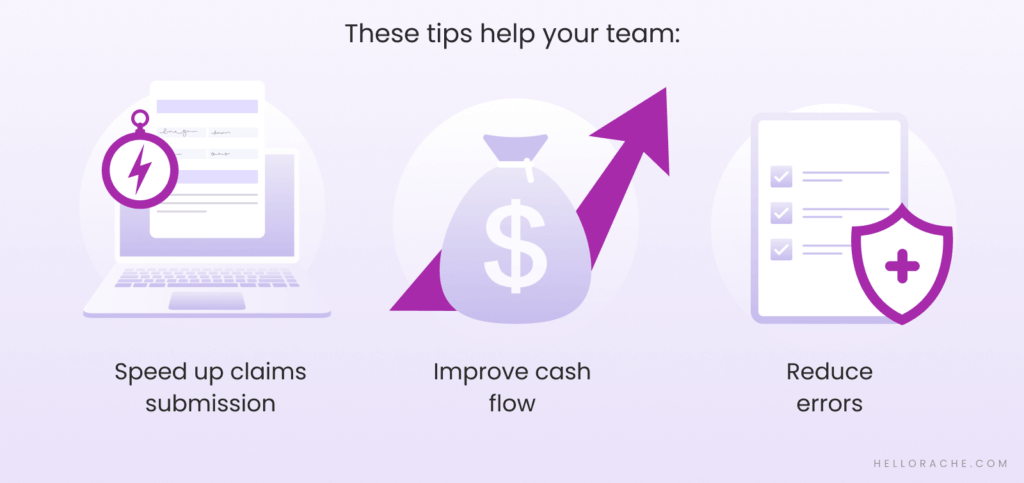
Here are ten practical ways to strengthen your medical billing process. These tips help your team:
- Speed up claims submission
- Improve cash flow
- Reduce errors
The right approach keeps your revenue cycle management on track. It also prevents avoidable claim denials.
Tip #1: Verify Patient Information Frequently
Accurate information is the starting point of clean insurance claims. If the details are incorrect or outdated, even a simple medical claim can be delayed or denied.
Start with insurance eligibility. Always confirm coverage before the visit. Check:
- What the patient is expected to pay
- What requires authorization
- What services are included
Many practices now use automated, real-time eligibility tools to speed up this process and reduce manual work.
Then, verify patient demographics. Confirm the patient’s name, date of birth, address, and contact details at every visit. It only takes a minute. But it prevents common medical billing errors that lead to claim rejections.
It also helps to double-check insurance details. This includes policy numbers and payer information. Remember, even one incorrect digit can disrupt the claims process.
Tip #2: Choose the Right Medical Billing Technology/Software
The tools you use affect your medical billing. If your system is slow or unreliable, errors and delays increase, impacting cash flow.
A solid system connects your EHR and billing software, so your team avoids double data entry.
Fewer manual steps usually mean fewer medical billing errors.
When evaluating billing software, look for features that support accuracy and speed:
- Electronic health records integration: This keeps clinical data and patient billing aligned in real time.
- Automated real-time eligibility: This instantly verifies insurance eligibility and coverage.
- Patient payment portal: It supports patient payments, mobile pay, and automated statements.
- Claim scrubbers: These review each medical claim before submission to catch errors early.
- Denial management tools: These help track claim denials and identify patterns.
These features don’t just save time — they also improve accuracy during claims processing.
More practices are also turning to automation. The HFMA says that in 2025, about 63% of healthcare organizations were already using AI and automation in the revenue cycle. Many planned to expand it to reduce workload, improve collections, and generate more revenue.
Tip #3: Stay Updated with Industry Changes
Medical billing is always moving. Codes get updated, and payers might adjust their rules. What worked a few months ago might not work today. When your team misses those changes, it often shows up as claim denials or delayed payments.
Even small updates can cause issues. A revised code in your coding systems or a new payer requirement can affect how a medical claim is reviewed. If your billing staff doesn’t catch it early, errors can slip through and slow down your revenue cycle.
The goal isn’t to track everything at once. It’s to stay consistent. A quick weekly check can go a long way. Over time, that habit helps keep your claims submission accurate and predictable.
There are a few reliable ways to stay informed. The American Academy of Professional Coders regularly shares coding updates and guidance. Most billing software platforms also flag changes inside the system. Payer portals and industry newsletters are useful too.
Tip #4: Optimize the Claims Submission Process
A strong claims submission process keeps your revenue cycle moving. When claims go out clean and on time, payments follow. When they don’t, delays build up fast and affect your cash flow.
Accuracy starts before submission. Make sure your patient demographics, insurance details, and coding all match the documentation. If something feels off, check it. Fixing it early prevents claim denials later.
Timing also matters. Submit each medical claim as soon as possible after the visit. This helps you catch issues while details are still fresh and avoids missing payer deadlines.
Claim scrubber tools (e.g., Aptarro ClaimStaker, Waystar, and Tebra (Kareo)) can help, too. They review claims before submission and flag issues right away. That gives your team a chance to correct problems before the insurance company sees them.
There are also a few common errors that cause unnecessary delays:
- Incorrect or incomplete patient demographics, such as the wrong date of birth or name spelling
- Missing or outdated insurance details, including policy numbers and payer information
- Lack of proper documentation to support the medical claim
- Coding mismatches between procedures and diagnosis codes
- Late claims submission that misses payer deadlines
Tip #5: Regularly Review Denied Claims
Denied claims are frustrating. But they’re also one of the best ways to spot problems in your medical billing process. Each denial tells you where something went wrong.
The key is not to rush past it. Take time to understand the reason behind the claim denials.
- Look at payer feedback
- Review the original medical claim
- Check supporting documentation
Most issues stem from coding errors, missing details, or incorrect insurance information.
Over time, patterns start to show. If the same issue keeps coming up, it’s not random. It points to a gap in your revenue cycle management that needs fixing.
To analyze denials more effectively, focus on:
- The root cause (coding, eligibility, or documentation issues)
- Whether the issue is recurring across multiple claims
- The payer’s reason codes and feedback
Appealing claims also need a clear approach. Don’t just resubmit and hope it works.
- Correct the original error before resubmitting
- Include complete and accurate documentation
- Follow the insurance company’s appeal process and timelines
Tip #6: Implement Patient Payment Strategies
Getting paid extends to patient responsibility. When the process is unclear, balances are often delayed.
It starts with expectations. Patients should understand their costs before the visit, not after. Clear estimates, upfront conversations, and simple patient billing reduce confusion later. When people know what to expect, they’re more likely to pay.
Collections also depend on how easy you make the process. If paying a bill takes too many steps, it gets delayed. Small changes here can make a big difference:
- Send automated statements and reminders at the right time
- Offer a patient payment portal with simple, secure access
- Enable mobile pay or text to pay for faster payments
Flexibility matters just as much. Not every patient can pay everything at once. Give them options that feel manageable:
- Allow partial payments instead of requiring full upfront amounts
- Clearly explain timelines and expectations to avoid confusion
- Set up structured payment plans based on balance size
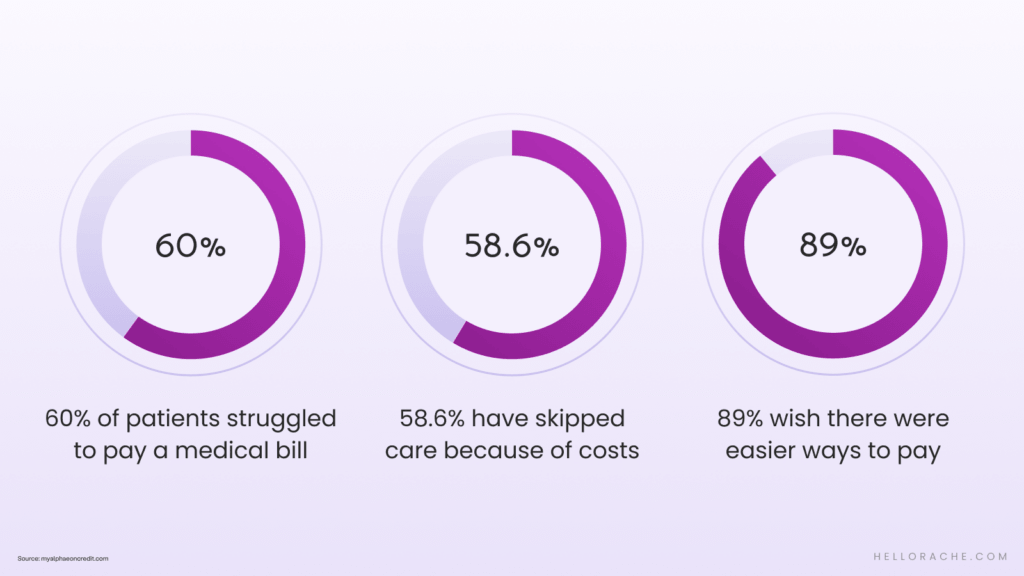
Cost can be a barrier for patients. A recent Alphaeon survey found that nearly 60% of patients struggled to pay a medical bill, and 58.6% have skipped care because of costs. On top of that, 89% wish there were easier ways to pay.
Tip #7: Monitor Financial Performance Regularly
If you’re not tracking your numbers, it’s hard to know where your medical billing process is working. And where it’s quietly losing revenue.
Regular tracking gives you a clear view of your revenue cycle. You start to see how fast payments come in, where delays happen, and how often claim denials occur. Without that visibility, small issues can go unnoticed until they affect your cash flow.
A few key metrics tell you most of what you need to know:
- Claim denial rate and common denial reasons
- Patient collection rate for patient payments
- Clean claims submission rate
- Days in accounts receivable
But tracking alone isn’t enough. You need to use the data. So look for patterns. If denials are rising, check the root cause. If payments are slowing, review your claims process.
Most billing and practice management software includes dashboards and reporting tools. These pull data from your EHRs and turn it into actionable information.
Over time, this helps you set clear short and long-term goals. You make better decisions, fix issues earlier, and keep your revenue cycle management steady.
Tip #8: Outsource When Necessary

Sometimes the best way to improve your medical billing is to step back and bring in outside support. Outsourcing medical billing can reduce workload, improve accuracy, and increase consistency in your revenue cycle.
It’s especially helpful when your internal team is stretched. Billing requires time, focus, and constant attention to detail. When that’s missing, medical billing errors increase, and so do claim denials.
There are clear advantages to outsourcing:
- More consistent cash flow and faster reimbursements
- Fewer errors and cleaner claims submission
- Access to experienced billing professionals
But there are trade-offs too:
- Need for strong communication with an external team
- Less direct control over day-to-day billing tasks
- Time required to onboard and align workflows
Choosing the right partner makes all the difference. Look for a provider that understands your workflows and communicates clearly.
For example, at Hello Rache, we provide Healthcare Virtual Assistants® who work as an extension of your team. They handle day-to-day billing tasks like claims submission, follow-ups, and documentation, helping reduce backlogs and keep your revenue cycle moving.
Because they integrate with your existing workflows, your team can stay focused on patient care while billing operations continue to run smoothly in the background.
Tip #9: Train Your Staff Regularly
If you don’t train your staff regularly, errors accumulate. And those errors often turn into claim denials and delays in your revenue cycle.
The issue is more common than it seems. According to Tebra, only about 18% of organizations offer monthly training focused on compliance changes and denial prevention. That leaves many teams trying to keep up with changing regulations, coding updates, and payer policies on their own.
Over time, that shows up in performance:
- More medical billing errors
- Slower claims submission
- More rework
Ongoing training helps prevent that. It keeps your team aligned with current coding systems, payer rules, and documentation standards. It also improves confidence, which leads to fewer mistakes.
You can support this with trusted programs. The American Academy of Professional Coders offers certifications and continuing education that help teams stay current.
With Hello Rache, training is part of how support is delivered. Our medical billing virtual assistants are prepared to handle real-world billing and administrative tasks. This includes a strong understanding of medical terminology, clinical workflows, and documentation standards used in everyday practice.
They also receive platform-specific training based on the type of practice they support. For example, assistants working with veterinary clinics are trained on VETport. Those who support dental practices are trained in Curve Dental Software.
Tip #10: Promote Clear Patient Communication
Clear patient communication plays a bigger role in medical billing than most practices expect. When patients don’t understand their costs, they delay payments or avoid them altogether. That directly affects your revenue cycle.
The gap is significant. Healthcare News states that only about 19% of patients say they usually understand their insurance coverage and costs before receiving care. This can have an impact on decision-making and access to care.
It starts with setting expectations early. Patients should know their financial responsibility before the visit. Explain expected charges, patient co-pays, and what their insurance company is likely to cover. This reduces confusion later.
Billing statements also need to be easy to understand. Avoid overly technical language. Break down charges clearly so patients can see what they owe and why. Simple, readable medical bills make a big difference.
It also gives patients a way to ask questions. A patient portal or a direct support channel can resolve issues quickly.
Build a Stronger Revenue Cycle With Smarter Billing Practices
Improving your medical billing doesn’t require a complete overhaul. Small, consistent changes can make a real difference. When your processes are accurate and timely, you:
- Speed up claims submission
- Reduce claim denials
- Improve cash flow
These medical billing tips and tricks work best when you apply them together. For example, these all help create a more stable system:
- Verifying patient and insurance information
- Improving patient communication
- Using the right billing software
- Training your team
In 2026, proactive practices will see the biggest gains. Those who refine their workflows now will be in a stronger position to manage complexity and maintain steady revenue.
Ready to improve your revenue cycle management without overloading your team?
SCHEDULE A CONSULTATION with Hello Rache and explore the support available to your practice.
Medical Billing FAQs
What Are the Top 5 Denials in Medical Billing?
Most claim denials come from a few common issues. These show up across many medical billing workflows and can disrupt your revenue cycle if you don’t address them early:
- Coding errors in medical billing and coding, or mismatched diagnosis codes
- Lack of proper documentation to support the medical claim
- Missing or invalid insurance details or eligibility issues
- Late claims submission or missed payer deadlines
- Incorrect or incomplete patient demographics
When you track these patterns, it becomes easier to fix the root cause and reduce repeat denials.
What Are the Three Pillars of Revenue Cycle Management (RCM)?
The revenue cycle management process follows a simple flow. It starts before the visit, continues during care, and finishes after the claim is paid.
- Front-end processes: These include patient registration, insurance eligibility, and the collection of accurate patient information.
- Mid-cycle processes: These cover medical billing and coding, documentation, and claims submission.
- Back-end processes: These focus on payments, denial management, and handling patient payments.
What Is the Golden Rule in Medical Billing?
The golden rule in medical billing is simple: Get it right the first time.
Accurate data, correct coding, and complete documentation are the foundation of a clean claims process. When a medical claim is submitted correctly, it’s more likely to be approved without delays or rework.
This reduces claim denials and speeds up reimbursement.
How Can I Reduce Claim Denials in Medical Billing?
Reducing claim denials usually comes down to getting the basics right, every single time. Most denials don’t occur because of complex issues. They happen because the team missed something small.
Start at the front end. Make sure patient data and insurance eligibility are accurate before the visit. If that information is wrong, the medical claim is already at risk.
Coding and documentation accuracy are important, too. The details need to match. If there’s a gap between what was documented and what was billed, the insurance company may reject it.
It also helps to review past denials. Look for patterns. If the same issue keeps recurring, it’s usually a process issue, not a one-time mistake.