Data breaches in healthcare are the most expensive of any industry, averaging over $7 million each. As cyber threats evolve and the digital footprint in healthcare expands, compliance has shifted from a simple legal checklist to the absolute cornerstone of patient trust.
For busy doctors and office managers, the challenge is two-fold:
- You must ensure that every interaction is secure and complies with the Health Insurance Portability and Accountability Act (HIPAA)
- At the same time, you must scale operations to meet patient demand
With the right protocols in place, integrating HIPAA-compliant medical assistants in your practice addresses both challenges.
This guide defines modern compliance, exploring how medical assistants, whether on-site or virtual, serve as the first line of defense. We’ll cover the regulations, risks, and rigorous standards required to keep your practice safe and compliant.
Highlights
- Medical assistants are often responsible for high-risk tasks regarding HIPAA compliance. Outsourcing these tasks doesn’t eliminate the risk of non-compliance with HIPAA standards due to mutual liability.
- Penalties for non-compliance with HIPAA standards can reach up to $2,134,831 and averaged $343,447 in 2025.
- Medical practices can reduce the risk of penalties by partnering with a healthcare virtual assistant agency like Hello Rache and executing proper Business Associate Agreements with their VAs.
- Demonstrating “good faith” to the Office for Civil Rights (OCR) after a breach is crucial for mitigating penalties.
Understanding HIPAA
HIPAA stands for the Health Insurance Portability and Accountability Act, a federal law passed in 1996 to protect patients’ private health data. It establishes national standards to prevent the disclosure of a patient’s sensitive health information without their consent or knowledge.
HIPAA covers a broad set of physical and electronic protected health information (PHI/ePHI) created, used, or disclosed when providing healthcare services, including:
- Any unique identifying number, characteristic, or code (e.g., Social Security Numbers (SSN), health plan beneficiary numbers, etc.)
- Digital footprints (web URLs accessed by the patient and IP addresses)
- Dates (birth dates, admission dates, discharge dates, etc.)
- Names (full names or even last name with initial)
- Contact Information
- Addresses
- And more
Since its inception, HIPAA has remained the gold standard for US privacy laws. The Department of Health and Human Services (HHS) is rigorous in its enforcement, meaning your staff’s understanding of these regulations must be flawless.
The Privacy Rule vs. The Security Rule
With that in mind, it‘s vital to distinguish between the two main arms of HIPAA regulation: The Privacy Rule and the Security Rule.
The Privacy Rule
The Privacy Rule regulates who has access to patient records. It sets the boundaries on the use and release of health information on a need-to-know basis.
For your practice, this means ensuring that a medical assistant only accesses the files necessary for their specific task, and nothing more.
The Security Rule
Conversely, the security rule mandates the technical safeguards for electronic health records (EHR). This deals with:
- Audit trails of the digital systems you use
- Access and Identity Management (AIM)
- Data encryption
- And more
When using virtual medical assistant services, the security rule is your primary focus. It dictates that the connection between your office and your remote staff must be impenetrable.
Business Associates Vs. Covered Entities Under HIPAA
Under HIPAA regulations, your medical practice is considered a “Covered Entity.” You have a direct relationship with the patient. However, when you hire third-party vendors — whether it’s an IT firm providing cloud services or a staffing agency like Hello Rache — they become “Business Associates.”
This relationship implies mutual liability under HIPAA.
A Business Associate Agreement (BAA) is therefore an absolute necessity. BAAs are legally binding contracts that ensure your remote medical assistants and the agency providing them agree to adhere to the same strict HIPAA regulations that you do.
The Risks of HIPAA Violations
Lastly, we must address the potential consequences of non-compliance.
According to IBM research, the average breach in 2025 cost healthcare providers $7.42 million, the highest among all industries. Furthermore, over a third of all breaches in 2025 resulted in regulatory fines, with 23% exceeding $250,000.
The stakes are high. Addressing all your security vulnerabilities is essential, and medical assistants (MAs) play a definitive role in this defense due to their numerous responsibilities, as outlined below.
Roles and Responsibilities of Medical Assistants
MAs often wear more hats than anyone else in the clinic. Their day-to-day duties are a blend of clinical and administrative tasks, many of which are high-risk in terms of compliance. From medical record-keeping to assisting with minor procedures, they’re constantly handling PHI.
Specifically, MAs are often responsible for claims processing and patient onboarding. These intake moments are critical because they’re where PHI enters your system.
In short, MAs act as the gatekeepers of patient confidentiality during care coordination and the stewards of your patient’s trust.
Training and Certification
HIPAA compliance requires training. But this isn’t a one-and-done event during orientation. It requires comprehensive training that is refreshed annually. This training must cover things like:
- How to handle confidential documents
- Social engineering attack prevention
- Password hygiene
There is immense value in hiring staff who come from a rigorous medical assistant program or have completed dedicated compliance workshops.
One of the distinct advantages of Hello Rache is that our Healthcare Virtual Assistants® are often registered nurses or allied health professionals in the Philippines. They have already undergone significant education on patient privacy and medical ethics before joining our platform.
In-House Medical Assistants vs. Virtual Medical Assistants
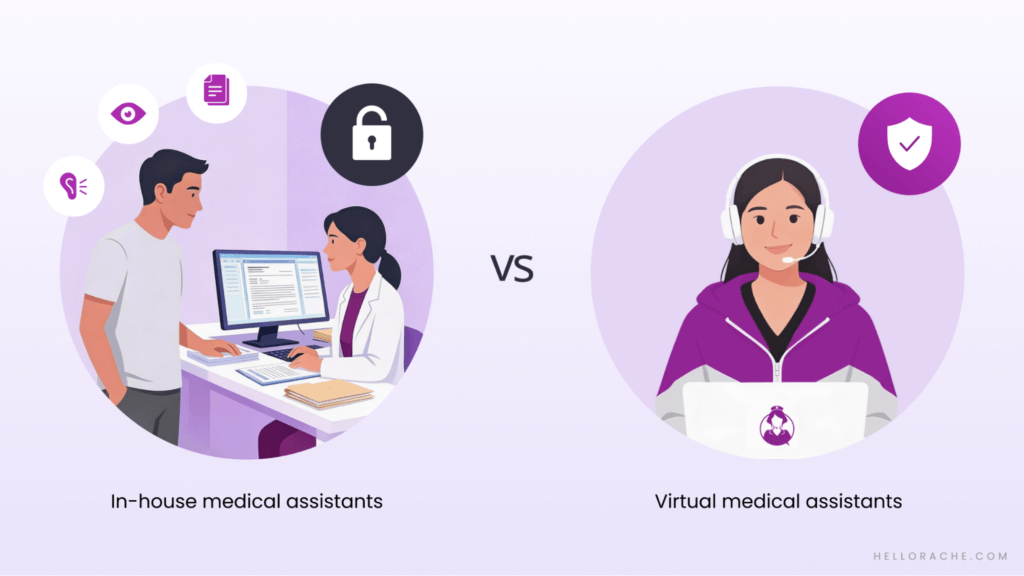
There is a persistent myth in the medical profession that in-house staff are inherently more secure than virtual healthcare assistants. In reality, the opposite is often true. A busy physical front office implies several risks:
- Unintended bystanders can overhear conversations in the waiting room
- Your staff can leave paper files on counters
- Patients can see computer screens
In contrast, virtual assistants like Hello Rache’s often operate from a controlled environment or a secure facility. This setup ensures you can outsource to a virtual assistant guilt-free.
Ensuring Compliance With Remote Teams
Managing a remote team of virtual medical assistants requires specific security protocols and rigorous standards to ensure continuous HIPAA compliance and protect patient data. These protocols include:
- Ensuring the use of encrypted devices and communication channels, and implementing employee monitoring standards
- Working with a reputable partner who standardizes the security setup
- Implementing a rigorous vetting process
Hello Rache helps maintain compliance through a rigorous Healthcare Virtual Assistant® vetting process. This process ensures that the professional logging into your system is exactly who they say they are.
Skills and Characteristics To Look for in a HIPAA-Compliant Medical Assistant
When recruiting new healthcare talent for your team, you want to have the right mix of technical and soft skills. Here’s what to look for when vetting candidates for a HIPAA-compliant medical assistant position.
Technical Skills To Look For
Proficiency and certification with HIPAA compliance tools and data protection software are an essential part of a HIPAA-compliant VA’s skill set. A few examples include:
- Health Information and Management Systems Society (HIMSS) toolkits
- Compliancy Group’s HIPAA Seal of Compliance
- ClearDATA (HIPAA-compliant cloud platform)
- Proofpoint (for email security and archiving)
- Spirion (formerly Identity Finder)
Familiarity with medical terminology is also a security asset. An assistant who understands the difference between various diagnoses is less likely to make transcription errors that could compromise data integrity.
Essential Soft Skills of a HIPAA-Compliant Medical Assistant
Beyond the technical requirements, specific soft skills contribute to a security-first mindset. You want to look for:
- Attention to detail in medical workflows
- Good organizational skills
- Excellent communication
- Problem-solving abilities
- Honesty
- Integrity
A compliant MA understands that cutting corners is grounds for termination.
Hello Rache excels at matching organizations with this top-tier talent. We provide professionals who aren’t just task-doers, but critical thinkers who understand the gravity of the data they handle.
Handling Sensitive Information: Do’s and Don’ts
Under HIPAA, your team must actively safeguard data integrity, ensuring every interaction meets strict ethical and legal standards. This means your virtual medical assistants should always:
- Implement multi-factor authentication (MFA): MFA is the most effective tool to ensure that even if a password is stolen, unauthorized users won’t easily access your systems.
- Adhere to the Minimum Necessary Rule: Access only the specific patient data strictly required to complete the immediate task at hand.
- Encrypt all digital transmissions: Use secure, HIPAA-compliant portals for sharing ePHI to avoid direct violations of the Security Rule.
- Use a secure VPN (Virtual Private Network): A VPN creates an encrypted tunnel between your VA’s computer and your office server.
- Verify recipient identity: Always confirm the identity of anyone (patient or provider) requesting records before disclosing them.
- Enforce a Clean Desk Policy: No sticky notes with passwords or patient data.
Furthermore, regular audits of access logs help you spot irregularities. Finally, don’t neglect cyber insurance. It provides a financial safety net in the event of a worst-case scenario.
Common Compliance Pitfalls and How To Avoid Them
Some common pitfalls that lead to HIPAA violations include:
- Discussing PHI in public areas
- Leaving devices unattended
- Sharing login credentials
- Reusing passwords
These pitfalls are much more common than you’d think and are easily avoidable.
For example, a survey by Bitwarden revealed that a quarter of respondents reuse passwords across 11 to 20 or more accounts. Worse still, 34% still write down their work account passwords on paper.
To avoid these pitfalls, make sure your team members:
- Never share accounts, as the Security Rule requires unique user identifiers to accurately track access logs
- Use password managers to set unique, strong passwords for all work accounts
- Avoid triage conversations in waiting rooms, hallways, or elevators
- Always lock their screen when walking away from a workstation
Technology and HIPAA: Tools for Compliance

Your human workforce is only as secure as the software ecosystem they inhabit. To demonstrate HIPAA compliance, it’s essential to periodically audit your technology stack:
- Ensure healthcare clearinghouses are encrypted end-to-end to secure electronic healthcare transactions between your practice and payers
- Look for EHR systems that offer granular access control, allowing you to limit what your VA sees based on their role
- Integrate your systems with a PULSE patient portal or similar secure gateways for safe patient interaction
Hello Rache’s VAs are trained to work within these and other platforms, ensuring adherence to your established security rules.
Responding to HIPAA Violations
Despite your best efforts, breaches can occur. If you suspect unauthorized access, these are the key steps to take to avoid being hit with a HIPAA penalty for non-compliance:
- Lock down the affected accounts and document the event in detail.
- Perform and document a 4-Factor Risk Assessment to determine the probability that PHI was compromised and the severity of the breach.
- If you find that unsecured PHI was compromised, follow the Breach Notification Rule: Notify all affected individuals within 60 days of discovery. For breaches affecting over 500 residents in a state/jurisdiction, you must also notify prominent media outlets and the Secretary of HHS.
- Prepare “Burden of Proof” documentation with a comprehensive audit trail to defend your response.
- Demonstrate “good faith” with the Office for Civil Rights (OCR) by immediately closing the security gap.
Penalties and Legal Consequences
Failure to follow the above protocol will likely result in a fine from the OCR. Fines are divided into four tiers, based on the level of culpability:
| Tier | Level of Culpability | Penalty Range per Violation |
|---|---|---|
| Tier 1 | Reasonable Efforts | $141–$71,162 |
| Tier 2 | Lack of Oversight | $1,424–$71,162 |
| Tier 3 | Neglect, rectified within 30 days | $14,232–$71,162 |
| Tier 4 | Neglect, not rectified within 30 days | $71,162–$2,134,831 |
Source: HIPAA Journal
To give you a more accurate idea of what these penalties could mean for your practice, so far in 2025:
- The highest fine has been a $1,500,000 penalty for violating the HIPAA Security Rule
- The average fine has been $343,447 (mostly in settlements)
- The lowest fine has been $5,000
So, despite legally being as low as $141 on paper, you’re most likely looking at penalties well into the six-figure range and above.
Real-Life Case Studies
Let’s look at real-world scenarios to see how this plays out.
Warby Parker: The Cost of Negligence
In February 2025, the OCR imposed a staggering $1.5 million civil monetary penalty on Warby Parker, a prominent retailer of prescription and non-prescription eyewear (source: HIPAA Journal).
The investigation revealed critical failures:
- Warby Parker failed to conduct a comprehensive risk analysis and didn’t have procedures in place to regularly review information system activity logs
- Hackers used a “credential stuffing” attack with reused usernames and passwords stolen from other sites
- The breach exposed patient data from 197,986 accounts
This case serves as a stark warning that even large commercial entities aren’t immune.
Private Dental Practice: Safeguarding Medical Alert PHI
In a specific investigation cited by the HHS, an undisclosed dental practice faced the following allegations:
- They were flagging medical records with a bright red sticker reading “AIDS” on the outside cover
- The stickers were visible to other patients and unrelated staff members
When the OCR intervened, the practice took immediate action by:
- Issuing formal apologies to the affected patients
- Immediately removing the offending stickers
- Revising its policies on medical alert PHI
The swift action and collaboration with the OCR helped this practice avoid a penalty, highlighting the importance of a proper post-breach response.
That said, this was a purely physical breach — a result of old-school, paper-based workflows that lacked privacy controls. Had they been working with a virtual assistant service like Hello Rache, this wouldn’t have happened in the first place.
Future Trends and Challenges in HIPAA Compliance
HIPAA compliance will only become more important in 2026 and beyond.
Looking ahead, administrative simplification will continue to drive the industry. AI will play a larger role in medical workflows, but it will require human oversight to ensure PHI data isn’t fed into public learning models.
We also face the challenge of protecting unique health identifiers in a global workforce. As borders dissolve for staffing, encryption, and legal frameworks like BAA’s become the glue that holds global compliance together.
Up-Grading Your Practice With HIPAA-Compliant Medical Assistants
HIPAA-compliant medical assistants aren’t just a staffing solution; they’re a strategic asset in safeguarding the integrity of the healthcare industry. Data security is a journey, not a one-time destination. It requires vigilance, the right technology, and the right partners.
As you look to scale your practice in 2026, don’t compromise on compliance. You can have efficiency and security simultaneously with Hello Rache.
FAQs
Yes, provided they work through a reputable agency. At Hello Rache, we ensure compliance by executing Business Associate Agreements, thoroughly vetting our VAs, and requiring them to use secure VPN connections and compliant environments.
They require initial and annual HIPAA training. Many of our professionals have backgrounds from the Health Tech Academy or nursing schools and participate in ongoing education to stay current with regulations.
A violation triggers the Breach Notification Rule. The individual may face termination and legal action, while the practice could face penalties. Having professional liability insurance and strict vetting minimizes this risk.