What types of virtual medical assistants are there, and which ones do we need?
As the demand for virtual support increases, it’s a question many healthcare professionals are asking.
Virtual MAs can handle a range of responsibilities — from scheduling and insurance follow-ups to clinical documentation and patient outreach.
So it helps to understand who does what before hiring one.
Our 10 types of virtual medical assistants guide explains their roles, qualifications, and skills. And how VMAs streamline workflows, reduce administrative burdens, and enhance patient care.
Highlights
- Clinical and administrative VMAs help healthcare professionals increase efficiency and enhance patient communication
- Administrative VMAs assist with the day-to-day operations of a healthcare practice
- Clinical VMAs perform medical scribing, telephone triage, remote patient monitoring, transcription, and specialty care
- Clinics use virtual assistants to reduce their workload and increase their patient care
- HIPAA-trained virtual assistants integrate into healthcare workflows and support long-term practice growth
Types of Virtual Medical Assistants (and How Each Supports Your Practice)
Virtual healthcare assistants fall into two core categories — clinical and administrative — and are human, AI, or a blend of both.
How they help:
A recent study by The Permanente Medical Group on virtual medical assistants found that:
- “AI scribes not only saved physicians an estimated 15,791 hours of documentation time — equal to 1,794 eight-hour workdays — but also improved patient-physician interactions and enhanced doctor satisfaction.”
The positive impact of VMAs on the healthcare system is becoming increasingly apparent.
The early signs show that VMAs help reduce documentation burden and work exhaustion, and improve physician–patient communication.
Human Virtual Medical Assistants
You’re hiring more than an extra pair of hands here. HVMAs are remote professionals who cover non-direct tasks that take time away from in-office staff and patient care.
Administrative VMAs keep your front office running by:
- Updating and organizing medical records
- Managing inbound calls and scheduling
- Running day-to-day operational tasks
- Handling insurance verifications
Clinical VMAs, like virtual scribes or triage assistants, support your clinical workflow by:
- Helping you stay ahead of documentation without sacrificing accuracy
- Managing patient messages and follow-up questions
- Prepping charts and updating patient information
- Documenting encounters in real time
AI-Powered Virtual Medical Assistant
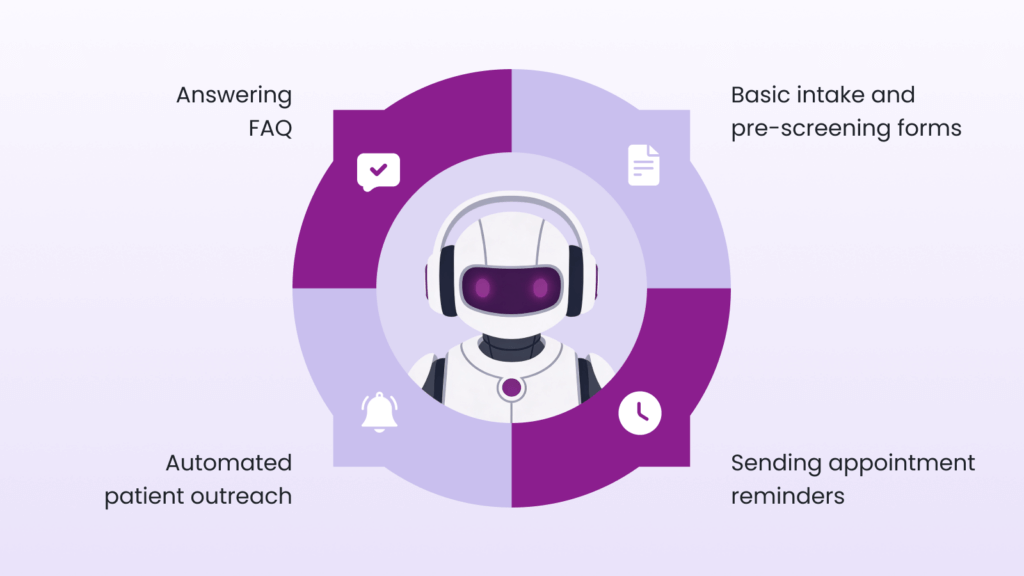
AI-powered assistants, like chatbots and voice agents, handle high-volume, repetitive tasks.
Knowing their capabilities helps you set realistic expectations and integrate AI-VMAs into your workflow.
You can use them for:
- Basic intake and pre-screening forms
- Sending appointment reminders
- Automated patient outreach
- Answering FAQ
To ensure smooth operations, medical offices need AI assistants that integrate with systems like Epic, Cerner, Athenahealth, or eClinicalWorks.
Which Type of Virtual Medical Assistant Does Your Practice Need?
Your healthcare practice’s specialty and workflow challenges help identify which virtual medical assistant you need.
Smaller clinics often start with a virtual medical receptionist to manage calls, scheduling, and front-desk duties.
As practices grow, many add a virtual administrative assistant to manage intake forms, follow-up messages, data entry, and patient communication.
Specialty groups — such as cardiology, pediatrics, dermatology, and orthopedics — often need virtual medical assistants with more profound medical knowledge.
Administrative Virtual Medical Assistants
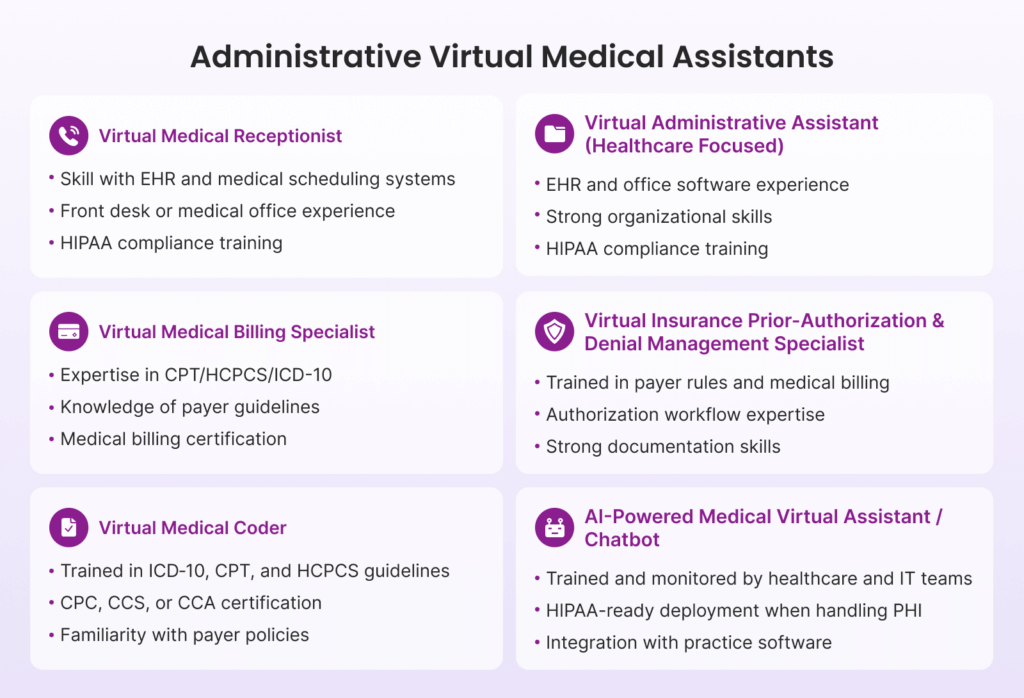
1. Virtual Medical Receptionist
A virtual medical receptionist handles front-desk tasks, including incoming calls, new-patient intake, scheduling, cancellations, reminders, and referral coordination.
Qualifications:
- Skill with EHR and medical scheduling systems
- Front desk or medical office experience
- HIPAA compliance training
How they help:
Virtual medical receptionists help reduce in-office workload, cut hold times, maintain consistent communication, and improve the patient experience.
Ideal for practices looking to streamline operations and reduce overheads, whilst extending service hours without increasing on‑site staffing.
2. Virtual Medical Billing Specialist
A virtual medical billing specialist manages a healthcare practice’s revenue cycle.
Tasks can include claims submission, insurance eligibility verification, payment posting, claim denial resolution, rejection, and appeal.
Qualifications:
- Expertise in CPT/HCPCS/ICD-10
- Knowledge of payer guidelines
- Medical billing certification
How they help:
A VMBS helps healthcare professionals reduce time spent navigating insurance complexities.
3. Virtual Medical Coder
VM coders translate clinical documentation into accurate billing codes, which are essential for insurance claims and for preventing compliance risk.
They review charts, verify documentation quality, and assign appropriate ICD-10, CPT, and HCPCS codes in accordance with audit standards.
Qualifications:
- Trained in ICD‑10, CPT, and HCPCS guidelines
- CPC, CCS, or CCA certification
- Familiarity with payer policies
How they help:
They help prevent denials, reduce audit risk, and ensure compliance with payer and regulatory standards.
4. Virtual Administrative Assistant (Healthcare Focused)
VAAs support day-to-day operations, including email management, data entry, appointment coordination, patient outreach, follow-up management, and digital file organization.
Qualifications:
- EHR and office software experience
- Strong organizational skills
- HIPAA compliance training
How they help:
Virtual administrative assistants reduce a clinic’s administrative burden and ensure smooth day‑to‑day operations by supporting patient communication and time management.
Making them ideal for clinics looking to optimize their internal processes.
5. Virtual Insurance Prior-Authorization & Denial Management Specialist
These specialists help reduce patient care delays by handling insurance verification, authorization, appeals, disputes, and follow-ups.
Whilst also ensuring the collection, submission, and tracking of all necessary documents.
Qualifications:
- Trained in payer rules and medical billing
- Authorization workflow expertise
- Strong documentation skills
How they help:
They can help prevent reimbursement losses because of authorization-related delays or denials.
6. AI-Powered Medical Virtual Assistant / Chatbot
AI-powered VAs automate patient communications and support tasks. They’re available 24/7 to schedule appointments, send reminders, and answer FAQs.
AI-MVAs can also collect patient intake details to provide symptom-based guidance.
Plus, they don’t need coffee breaks or holidays!
Qualifications:
- Trained and monitored by healthcare and IT teams
- HIPAA-ready deployment when handling PHI
- Integration with practice software
How they help:
AI assistants streamline administrative tasks and provide instant, reliable patient support.
Clinical Virtual Medical Assistants
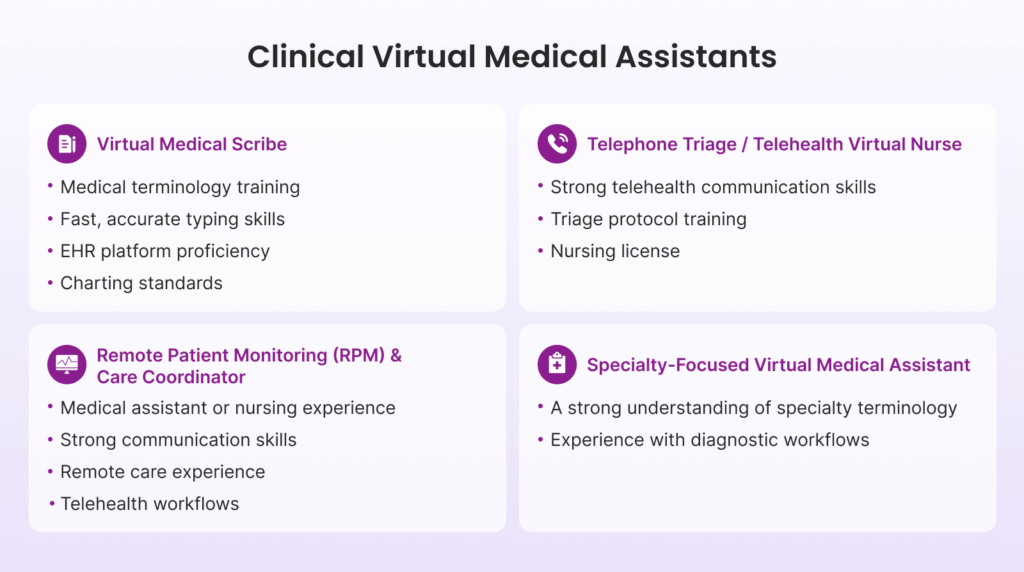
7. Virtual Medical Scribe
Medical scribes record patient/health provider interactions in real time to document them in the EHR. Documentation tasks include patient history, exam results, diagnoses, and treatment plans.
Qualifications:
- Medical terminology training
- Fast, accurate typing skills
- EHR platform proficiency
- Charting standards
How they help:
A CVMA helps reduce charting burdens, improve documentation accuracy, and increase patient visit efficiency.
8. Remote Patient Monitoring (RPM) & Care Coordinator
RPMC coordinators support chronic disease management by monitoring remote devices and data to review patient symptoms and identify early risks.
Qualifications:
- Medical assistant or nursing experience
- Strong communication skills
- Remote care experience
- Telehealth workflows
How they help:
RPMs help support proactive care, reduce hospitalizations, ensure continuous patient monitoring, and are essential for chronic care programs.
9. Telephone Triage / Telehealth Virtual Nurse
Triage nurses evaluate symptoms, assess urgency, schedule appointments, and direct patients to the appropriate care, following clinical protocols.
TVNs also help strengthen your telehealth workflow by preparing virtual patient visits, providing tech guidance, and organizing remote data monitoring.
Qualifications:
- Strong telehealth communication skills
- Triage protocol training
- Nursing license
How they help:
Telehealth virtual nurses reduce unnecessary patient visits, support urgent care decisions, and improve resource allocation.
Enabling your medical practice to expand its care access and enhance its patients’ treatment.
10. Specialty-Focused Virtual Medical Assistant
Specialty-focused VMAs support specific departments, including cardiology, dermatology, pediatrics, orthopedics, dentistry, and OB-GYN.
Their duties include ordering labs, preparing specialty forms, coordinating procedures, and supporting patient follow-ups.
Qualifications:
- A strong understanding of specialty terminology
- Experience with diagnostic workflows
How they help:
Clinics enjoy greater accuracy, smoother workflows, and more specialized patient support.
How To Choose a Virtual Medical Assistant
Start by evaluating your practice’s workflow to identify tasks suitable for virtual support. Then, compare the capabilities of medical virtual assistant providers to find the best match.
Your goal is to choose a VMA that improves your practice’s operational efficiency and offers a measurable ROI.
Many healthcare professionals improve efficiency by hiring two VMAs. One for billing or coding and another for patient coordination.
Choosing the right medical virtual assistant can provide a scalable, cost-effective solution.
The Future of Virtual Medical Assistants
Virtual medical assistants are fast becoming essential staff members in healthcare practices.
Enabling healthcare professionals to focus on delivering high-quality patient care whilst avoiding administrative burnout.
Ready to streamline your healthcare practice and scale smarter with Hello Rache?
Types of Virtual Medical Assistants FAQs
1. What Is a Virtual Medical Assistant?
VMAs are remote professionals who support the healthcare industry with administrative or clinical tasks using HIPAA-compliant tools and workflows.
2. How Do Virtual Medical Assistants Help a Clinic?
VMAs help reduce a clinic’s workload, scale to meet demand, improve internal/patient communication, and reduce costs.
3. What Qualifications Do VMAs Need?
VMAs need clinical or administrative training, EHR skills, and knowledge of HIPAA compliance.
4. Are Virtual Medical Assistants HIPAA Compliant?
VMAs should operate within HIPAA systems and follow privacy and data security protocols.
5. How Do AI Assistants Compare to Human VMAs?
AI assistants handle structured or repetitive tasks. Human VMAs manage real-time patient and clinic demands and specialized workflows.